You’ve been staring at your to-do list for 20 minutes. Not because you don’t know what to do. Because everything on it feels equally urgent and none of it feels like the right place to start.
That’s what happens when your business runs on momentum instead of clarity. And understanding how clarity reduces overwhelm is the difference between spinning in circles and actually moving your business forward.
Four shifts. None of them require a new tool or a weekend planning retreat.
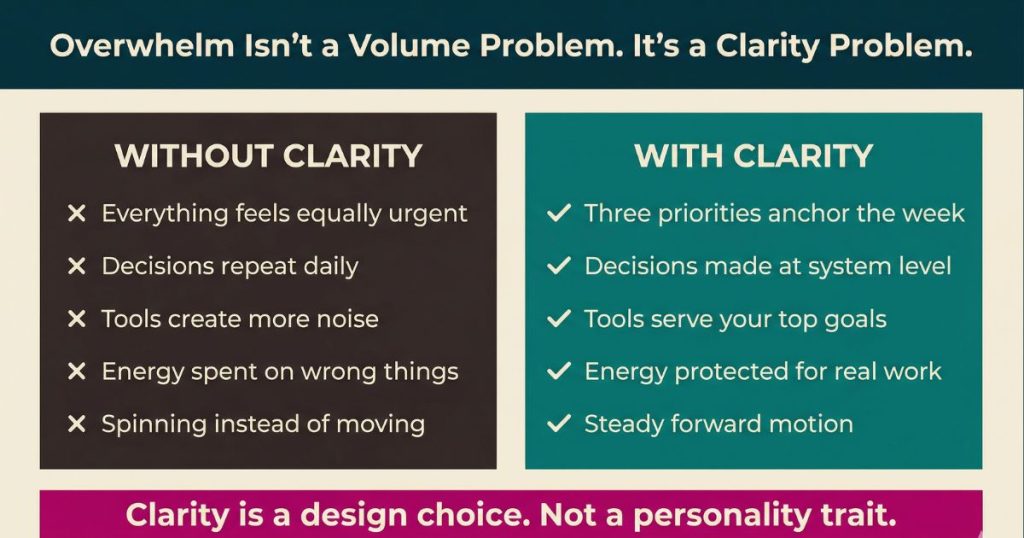
Why Overwhelm Isn’t Really About Having Too Much to Do
Most advice treats overwhelm like a volume problem. “Do less.” “Delegate more.” “Say no.” That’s fine in theory, but it misses the actual issue.
Overwhelm usually comes from unclear priorities, not an impossible workload. When you don’t know what matters most this week, every task competes for the same mental space. Forbes calls this “the clarity crisis” in leadership, and it applies directly to founders running solo or with small teams.
Decision fatigue for entrepreneurs compounds fast. Each unclear priority creates a chain of micro-decisions downstream. What to post. Who to follow up with. Which offer to promote. By noon, your brain has spent its decision-making budget on things that should have been settled at the system level.
Clarity is a design choice. And it’s one you can make right now.
4 Simple Shifts From Overwhelm to Clarity
Shift 1: Define Your Three Priorities Per Week
Not ten. Not the whole project list. Three things that move your business forward this week. Everything else is maintenance or can wait.
Write them down on Monday. Refer back when decision fatigue hits. “Is this one of my three?” becomes the filter for every request, every distraction, every bright idea that tries to hijack your afternoon.
This alone reduces the overwhelm-to-clarity gap faster than any productivity system. Business clarity strategies don’t need to be complex to work.
Shift 2: Separate Thinking Time From Doing Time
Overwhelm spikes when you try to plan and execute in the same block. Your brain switches between creative mode and task mode, and neither one gets enough runway.
Block 20 minutes at the start of your week for thinking only. What’s working? What’s creating friction? What decision have you been avoiding? Then close the notebook and shift to doing. Entrepreneur highlights how decision fatigue is measurably costing small business owners money. Separating the two modes protects the quality of both.
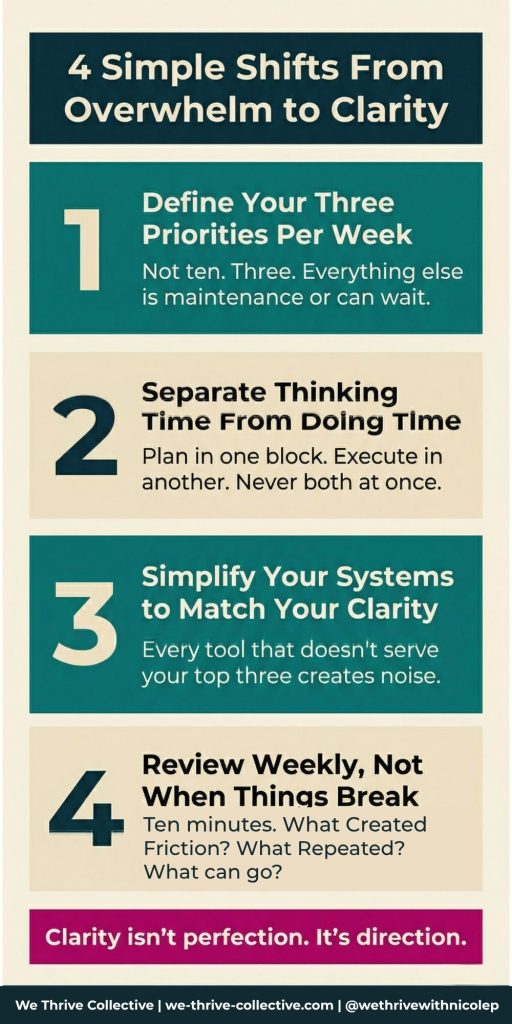
Shift 3: Simplify Your Systems to Match Your Clarity
Once you know your priorities, your tools should serve those priorities and nothing else. Every tool in your stack that doesn’t directly support your top three creates noise.
This is where simplifying your business systems directly reinforces clarity. Fewer tools means fewer logins, fewer context switches, and fewer places where information hides. Your systems should reflect your priorities, not compete with them.
For neurodivergent founders especially, system complexity amplifies overwhelm. If your tools require more cognitive load than the work itself, that’s a clarity problem wearing a technology disguise. Building neurodivergent-friendly business systems is one of the most effective ways to protect clarity at the operational level.
Shift 4: Review Weekly, Not When Things Break
Most founders only evaluate their systems when something goes wrong. By then, the overwhelm has already compounded.
A 10-minute weekly review changes this. Ask three questions: What created friction this week? What decision did I make more than once? What can I automate, delegate, or drop?
This rhythm turns clarity into a practice instead of a crisis response. Over time, your business runs on fewer decisions, fewer fires, and more forward motion.
Frequently Asked Questions
How does clarity reduce overwhelm for entrepreneurs?
Clarity reduces overwhelm by narrowing your focus to what actually matters. When priorities are defined and systems support those priorities, you make fewer decisions per day. That reduces mental fatigue, frees up creative energy, and makes forward motion feel possible instead of exhausting.
What is decision fatigue and why does it affect entrepreneurs?
Decision fatigue is the mental drain from making too many choices in a short period. Entrepreneurs face it daily because they handle everything from strategy to admin. When each decision competes for the same limited energy, quality drops and overwhelm increases.
What are business clarity strategies that actually work?
The most effective business clarity strategies are simple: define three weekly priorities, separate thinking from doing, simplify your tool stack to match your goals, and review your systems weekly. Complexity rarely solves the problem it promises to.
Can clarity help with ADHD-related business overwhelm?
Yes. Neurodivergent founders experience decision fatigue faster because fragmented systems demand more working memory. Clarity through simplified systems, visual organization, and defined priorities reduces the cognitive load that triggers overwhelm in the first place.
How often should I review my business systems for clarity?
Weekly reviews of 10 minutes work best. Ask what created friction, what decisions repeated, and what can be automated or removed. Monthly or quarterly reviews catch bigger structural issues. The goal is to prevent overwhelm before it builds, not react after it peaks.

Overwhelm isn’t a character flaw. It’s feedback. Your business is asking for clearer structure.
Start with one shift. Define your three priorities for next week. Write them somewhere you’ll actually see them. That’s the first move from spinning to steady.
Clarity isn’t perfection. It’s direction. And direction is enough to change how Monday feels.