
What AI-Ready SEO Actually Means in 2026
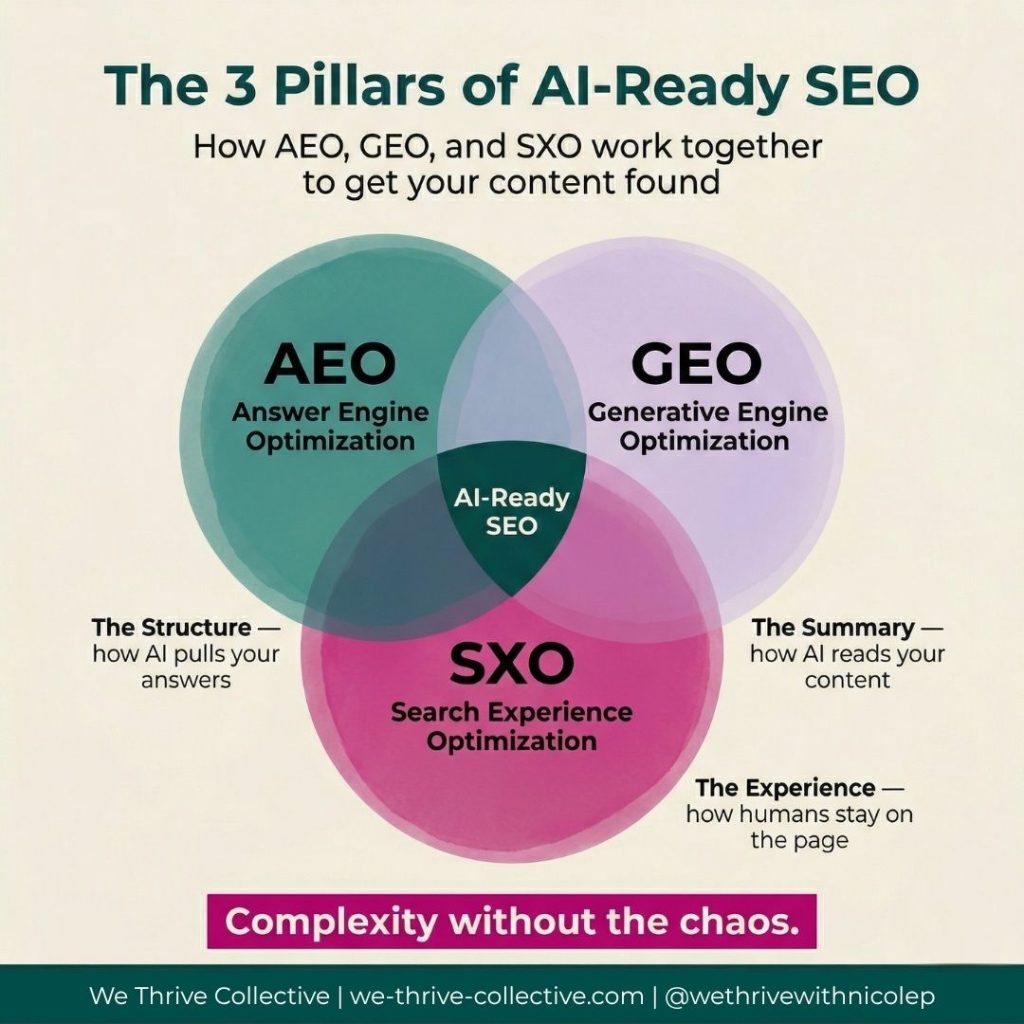
AI-ready SEO means writing content that both humans and AI can understand, trust, and pull from. Three practices make this work, and they’re not as complicated as they sound.
Answer Engine Optimization (AEO) is about structuring your content so tools like Google AI Overviews and ChatGPT can grab your answer directly. AI Overviews now show up in over 55% of Google searches. If your content isn’t formatted for that, you’re writing into a void.
Generative Engine Optimization (GEO) is how AI tools decide whether they can summarize your content accurately. Clean headings, labeled sections, and structured data tell machines what you actually cover instead of making them guess.
Search Experience Optimization (SXO) is the human layer. It makes your content calming to read so people stay longer and feel something. For neurodivergent readers who process visual hierarchy and white space differently, this is the difference between “I’ll come back to this” and actually reading the whole thing.
When those three click together, your content gets found by machines and trusted by people. That’s AI-ready SEO for neurodivergent founders who want visibility without the chaos spiral.
5 Calm Steps to AI-Ready SEO
Step 1: Start With Real Questions You Already Answer
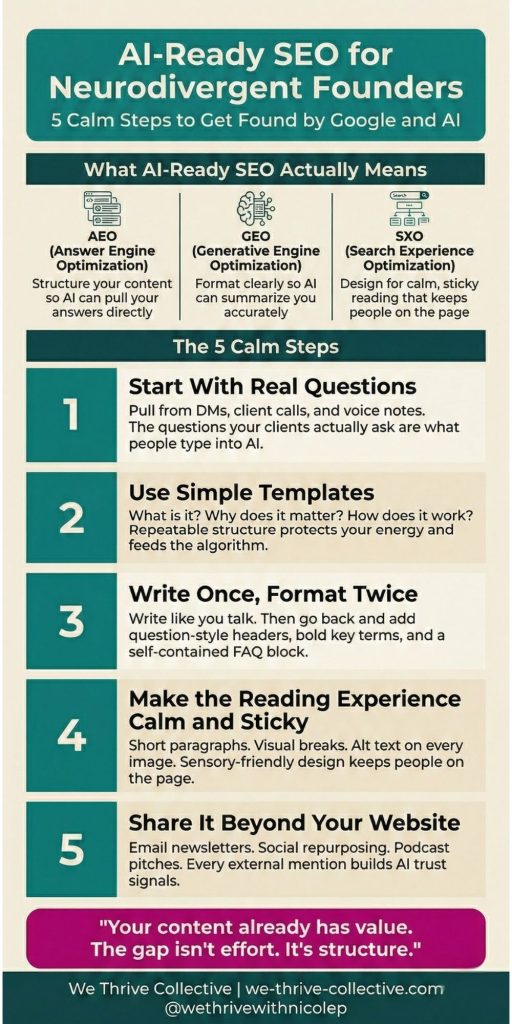
Forget keyword tools for now. Open your DMs, client intake forms, or voice notes from the last month. The questions your clients actually ask are the ones real people type into Google and speak into AI assistants.
Turn each question into a heading. Write the answer the way you’d say it on a voice note. That conversational clarity is exactly what answer engine optimization rewards for small businesses.
Step 2: Use Simple Templates to Structure Your Content
If your brain doesn’t work in linear outlines, you’re not alone. Mine doesn’t either. Use a repeatable template instead: What is it? Why does it matter? How does it work? Then add three to five FAQ pairs at the end.
That gives AI engines clean sections to pull from. And it gives your brain a container so you’re not reinventing the wheel every time you sit down to write. For a deeper look at building repeatable systems that protect your energy, this post on simplifying your business systems walks through the full approach.
Step 3: Write Once, Format Twice
Write your content the way you naturally talk. Then go back and format it for machines: add question-style subheadings, bold your key definitions, and build a mini FAQ block with 40 to 60 word answers that stand on their own.
That second formatting pass is where GEO for entrepreneurs actually lives. AI tools scan your headings and pull self-contained answers. If your FAQ says “as mentioned above,” it gets skipped entirely. Every answer has to work like it’s the only thing someone reads.
Step 4: Make the Reading Experience Calm and Sticky
Neurodivergent readers stay longer on pages with clear visual hierarchy, short paragraphs, and breathing room between sections. So does everyone else. That time-on-page signal tells Google your content is worth showing.
Add alt text to every image. Break up text with visuals. Use readable fonts and enough white space that the page doesn’t feel like a wall of text. This is SXO in practice, and it’s where neurodivergent-friendly business systems naturally extend into your content strategy.
Step 5: Share It Beyond Your Website
AI engines learn what to cite based on where your content shows up across the internet. Share your post in your email newsletter, repurpose the key points for social, pitch related angles to podcasts.
Every external mention builds what Google calls E-E-A-T: experience, expertise, authoritativeness, and trustworthiness. The more places your content appears with proper attribution, the more AI treats it as a citable source.
Frequently Asked Questions
What does AI-ready SEO mean for neurodivergent founders?
AI-ready SEO for neurodivergent founders means structuring your content so both humans and AI search engines can find, understand, and cite it. It combines answer engine optimization, generative engine optimization, and search experience design into a calm, repeatable process built for brains that don’t think in straight lines.
What is the difference between AEO, GEO, and SXO?
AEO formats content so AI tools can pull direct answers. GEO structures content so AI can summarize it accurately. SXO designs the reading experience so it feels calming and keeps people on the page. Together, they form a complete AI-ready SEO strategy for both machines and real humans.
How do I optimize my content for Google AI Overviews?
Answer real questions directly in your first two sentences under each heading. Use question-format subheadings, write self-contained FAQ answers between 40 and 60 words, and add structured data markup. Pages with clear formatting get cited 40 to 60% more often in AI Overviews.
Can non-linear thinkers actually do SEO well?
Yes. Non-linear thinking is an advantage for AI-ready SEO because it naturally connects ideas across topics that linear thinkers keep in separate boxes. Use simple templates for structure, then let your brain do what it does best. The template holds the form. Your thinking fills it with depth.
How long does it take to see results from AI-ready SEO?
Most founders see indexing improvements within two to four weeks of adding structured data and reformatting content. Real traffic growth compounds over eight to twelve weeks as AI engines learn to trust your content patterns and citation signals build across platforms.
Your content already has value. The gap isn’t effort. It’s structure that lets both people and machines recognize what you already know.
Pick one post. Choose a question your clients ask every week. Write the answer. Format it twice. Add the schema. Hit publish.
That’s how steady visibility builds. One clear, calm piece of content at a time.