You bought the project management tool everyone recommended. Set it up on a Sunday. Used it for nine days. Then opened a Google Doc instead because the tool felt like homework.
That’s not a discipline problem. That’s a design mismatch. Most business tools were built for brains that think in straight lines and follow the same routine every day. Neurodivergent business systems start from a different assumption: your brain has its own logic, and your tools should match it.
Here are five shifts that make that real.
Why Traditional Systems Break for Neurodivergent Founders
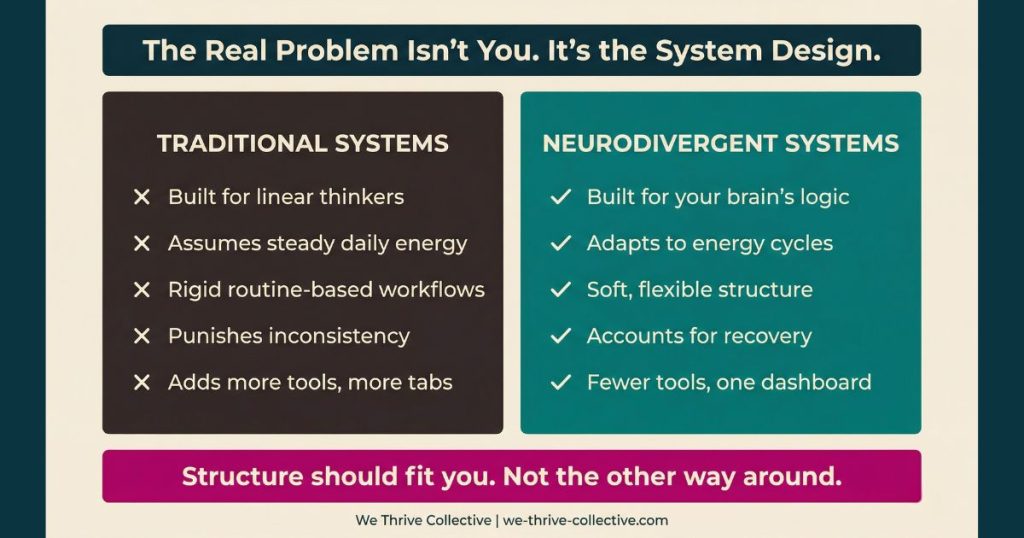
Traditional CRMs, task managers, and “productivity stacks” assume you’ll follow the same workflow daily. They expect consistent energy, linear execution, and clean handoffs from one step to the next.
If you’re neurodivergent, that assumption falls apart by Tuesday.
Harvard Business Review put it clearly: asking neurodivergent people to conform to neurotypical systems causes more harm than help. The most effective working relationships happen when the structure adapts to the person, not the other way around.
For ADHD, autistic, and otherwise neurodivergent founders, rigid systems create decision fatigue, shame spirals after missed steps, and the quiet belief that something is wrong with you. Nothing is wrong with you. The system was wrong for you.
5 Real Shifts to Build Neurodivergent Business Systems
Shift 1: Replace Rigid Routine With Soft Structure
Soft structure is the middle ground between chaos and a color-coded calendar you’ll abandon by Wednesday. It means having repeatable containers for your work without locking yourself into hour-by-hour schedules.
Instead of time blocking, try energy-based batching. Group tasks by the type of energy they need: creative work when your brain is firing, admin when it’s coasting, rest when it’s done. Your neurodivergent entrepreneur systems should flex with your capacity, not punish you for having a different Tuesday than last Tuesday.
Shift 2: Consolidate Your Tools
The average small business uses over 170 apps. For neurodivergent founders, every extra login is another context switch, another place to lose a thread, another chance for something to slip.
ADHD-friendly business tools live in as few places as possible. One platform for client communication, scheduling, and automations. One dashboard you actually open. The fewer tabs, the fewer decisions. That’s the real simplification. For a deeper look at how to audit and consolidate, this post on simplifying business systems walks through the full process.
Shift 3: Automate the Tasks Your Brain Forgets
Follow-up emails. Invoice reminders. Onboarding sequences. These aren’t hard tasks. They’re the ones that fall through the cracks when your working memory is already full.
Automation removes the things your brain consistently drops so you can stop carrying the mental weight of “did I send that?” Build your automations around the patterns you already see. Not aspirational workflows. Real ones.
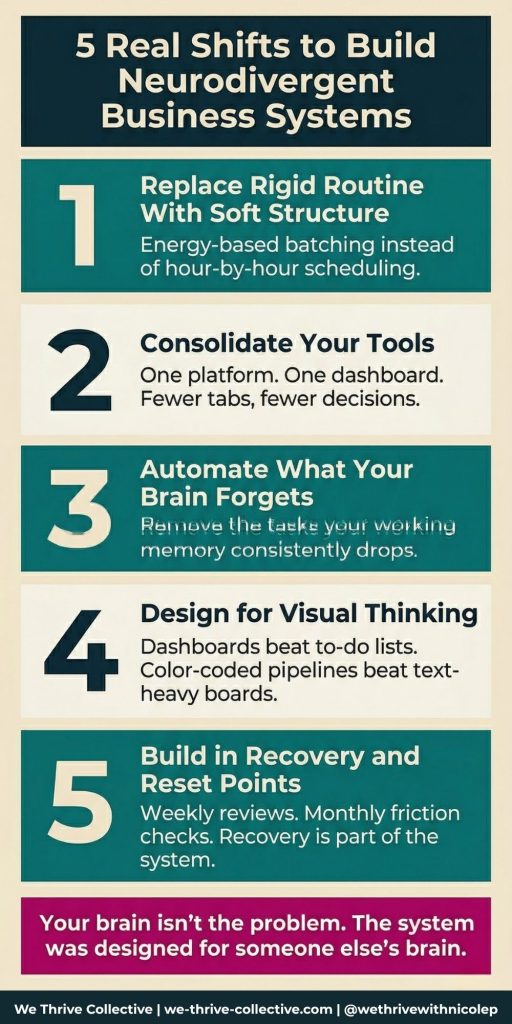
Shift 4: Design for Visual Thinking
Neurodivergent brains often process information visually. Dashboards beat to-do lists. Color-coded pipelines beat text-heavy project boards. If your system requires reading three paragraphs to figure out what’s next, it’s not built for how you think.
A soft structure business model uses visual cues and spatial organization to reduce the cognitive load of figuring out where you are and what comes next. When you can see your business at a glance, decisions get faster and less draining.
Shift 5: Build in Recovery and Reset Points
Neurotypical systems assume steady energy. Neurodivergent systems need to account for the crash after the hyper-focus sprint, the day when everything feels heavy, the week where capacity drops.
Build reset points into your systems. A weekly 10-minute review. A monthly “what’s creating friction” check-in. When your systems include recovery by design, falling off track stops being a failure and starts being part of how clarity reduces overwhelm over time.
Frequently Asked Questions
What are neurodivergent business systems?
Neurodivergent business systems are workflows, tools, and structures designed for brains that don’t follow linear, routine-based patterns. They use soft structure, visual organization, energy-based planning, and built-in recovery points to support founders with ADHD, autism, and other neurodivergent wiring.
What is a soft structure business model?
A soft structure business model uses flexible containers instead of rigid routines. It means repeatable frameworks without strict schedules, energy-based batching instead of time blocking, and systems that adapt to your capacity rather than demanding consistency your brain can’t sustain.
Why do traditional business tools fail neurodivergent entrepreneurs?
Traditional tools assume daily consistency, linear execution, and steady energy. Neurodivergent brains work in cycles of focus and fatigue, process information visually, and experience decision fatigue faster when switching between fragmented systems that weren’t designed for them.
How do I build ADHD-friendly business tools into my workflow?
Start by consolidating into fewer platforms. Automate the repetitive tasks your working memory drops. Use visual dashboards instead of text-heavy lists. Design your workflows around energy patterns, not clock hours. Small structural changes reduce friction faster than a full rebuild.
Can neurodivergent business systems scale as my business grows?
Yes. Soft structure scales better than rigid systems because it’s built to adapt. As your business grows, the containers expand. The automations handle more volume. The visual systems accommodate more complexity without adding proportional cognitive load.
Your brain isn’t the problem. The system was designed for someone else’s brain. That’s fixable.
Start with one shift. Whichever one made you exhale a little just reading it. That’s your entry point.
Neurodivergent business systems aren’t about accommodation. They’re about building something that actually fits.