You have seven tabs open, three apps pinging you, and a sticky note on your monitor that says “fix CRM.” You’ve been meaning to consolidate your tools for months. Instead, you added another one last week.
That’s not a productivity problem. That’s a systems design problem. And when you simplify business systems the right way, the relief is almost immediate.
Four steps that actually work for service-based founders who are tired of duct-taping their operations together.
Why Most Business Systems Create More Overwhelm
Most tools promise ease. What they deliver is one more login, one more dashboard, and one more thing to check before your morning coffee gets cold.
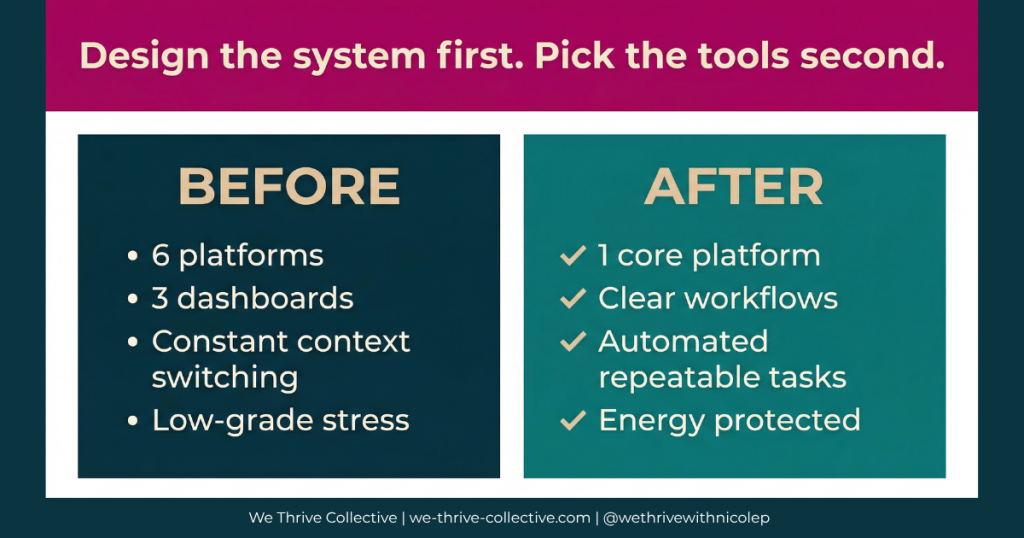
The issue isn’t that you chose bad tools. It’s that nobody told you to design the system first and pick the tools second. When you skip that step, you end up with six platforms doing three jobs, none of them talking to each other.
Research on decision fatigue confirms what you already feel: every unnecessary decision drains energy you could spend on actual client work. And for neurodivergent founders who process information differently, fragmented systems hit even harder.
The cost isn’t just time. It’s the low-grade stress of never knowing if something slipped through the cracks.
4 Honest Steps to Simplify Business Systems
Step 1: Audit What You Actually Use
Open your browser history from last week. That tells you more than any tool inventory spreadsheet.
Write down every platform you touched. Next to each one, note whether it actively helped you or whether you opened it out of habit. Be honest. If you haven’t logged into something in three weeks, it’s not a system. It’s clutter.
This audit alone usually cuts 20-30% of the noise. You can’t simplify business systems you haven’t actually looked at.
Step 2: Consolidate Around One Core Platform
The fastest way to streamline business operations for solopreneurs is to stop spreading your work across five tools that each do 40% of what you need.
Pick one platform that handles the core of your business: client communication, scheduling, automations, and content. Then ask what can be retired. Zapier’s research on tool consolidation shows the average small business uses 170+ apps. Most founders can cut that number in half without losing a single function.
If you’re exploring what a consolidated system looks like in practice, this post on neurodivergent-friendly business systems walks through how to build one that fits how your brain actually works.
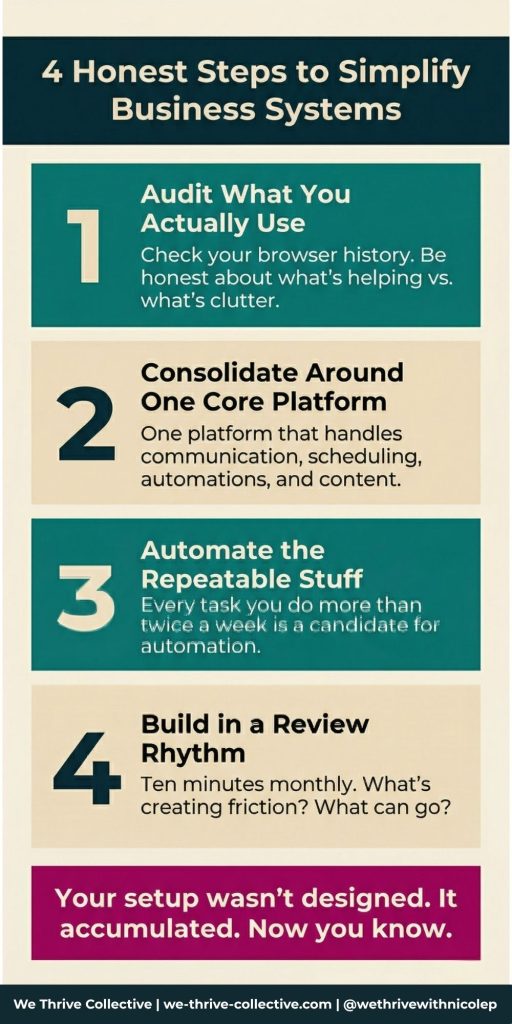
Step 3: Automate the Repeatable Stuff
Every task you do more than twice a week is a candidate for automation. Client intake emails, appointment confirmations, follow-up sequences, invoice reminders. These don’t need your hands on them every time.
Automation protects your energy for the work that actually needs you present. The goal is to reduce business overwhelm at the operational level so your creative energy stays available for client work.
Start small. Automate one thing this week. See how it feels. Then do another.
Step 4: Build in a Review Rhythm
Systems drift. What worked three months ago might not fit anymore. That’s not failure. That’s iteration.
Set a monthly check-in with yourself. Ten minutes. Ask: What’s creating friction? What did I add that I don’t need? Where am I spending energy that a system should handle?
This is where clarity reduces overwhelm in a practical, ongoing way. Regular review keeps your systems clean and your brain calm.
Frequently Asked Questions
What does it mean to simplify business systems?
Simplifying business systems means reducing the number of tools, steps, and decisions required to run your operations. It’s not about doing less work. It’s about designing workflows that match how you think so your energy goes toward serving clients, not managing complexity.
How do I know if my business systems are too complicated?
Common signs include avoiding your own tools, rebuilding workflows every few months, feeling drained after admin tasks, and second-guessing simple decisions. If maintaining your systems takes more energy than the work itself, something needs to change.
Can I simplify my systems without starting over?
Yes. Business system consolidation doesn’t require a full rebuild. Start by auditing what you use, retiring what you don’t, and consolidating where two tools do the same job. Small changes compound faster than most founders expect.
What’s the best platform for consolidating business tools?
The best platform depends on your business model and working style. Look for something that handles your core operations in one place rather than bolting together separate tools. The right fit reduces logins, context switching, and the mental overhead of managing disconnected systems.
How long does it take to feel the difference after simplifying?
Most founders notice relief within the first week of cutting unnecessary tools and automating repetitive tasks. Deeper benefits compound over four to eight weeks as your streamlined systems become second nature and decision fatigue drops.
Your current setup wasn’t designed. It accumulated. And that’s fine. Now you know.
Pick one step from this post. Do it this week. That’s enough to start.
Simpler systems aren’t about perfection. They’re about making space for the work you actually care about.