Soft Structure for Sustainable Business: 5 Real Shifts
You bought the planner. Color-coded it on a Sunday. Used it for eleven days. Then abandoned it because your week never once matched what you’d mapped out.
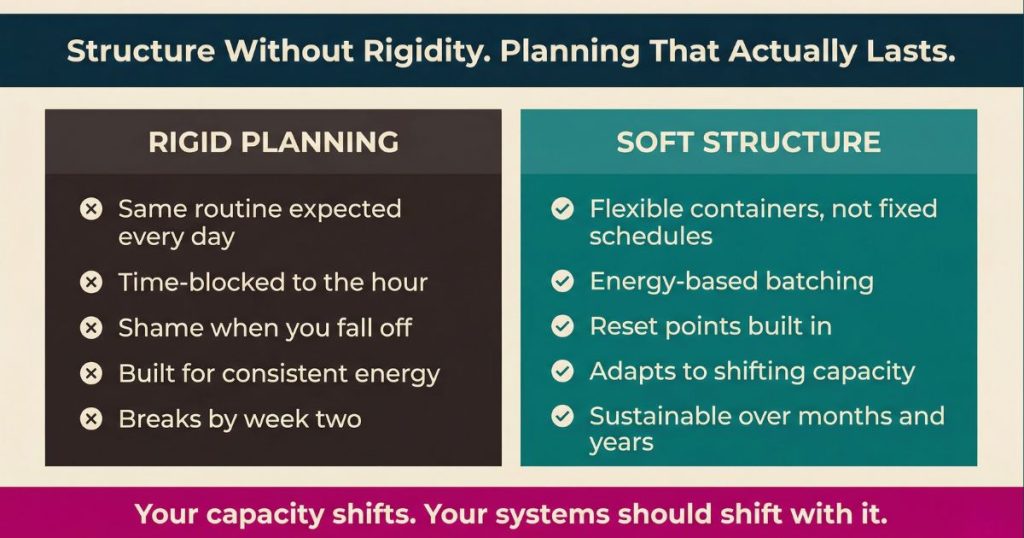
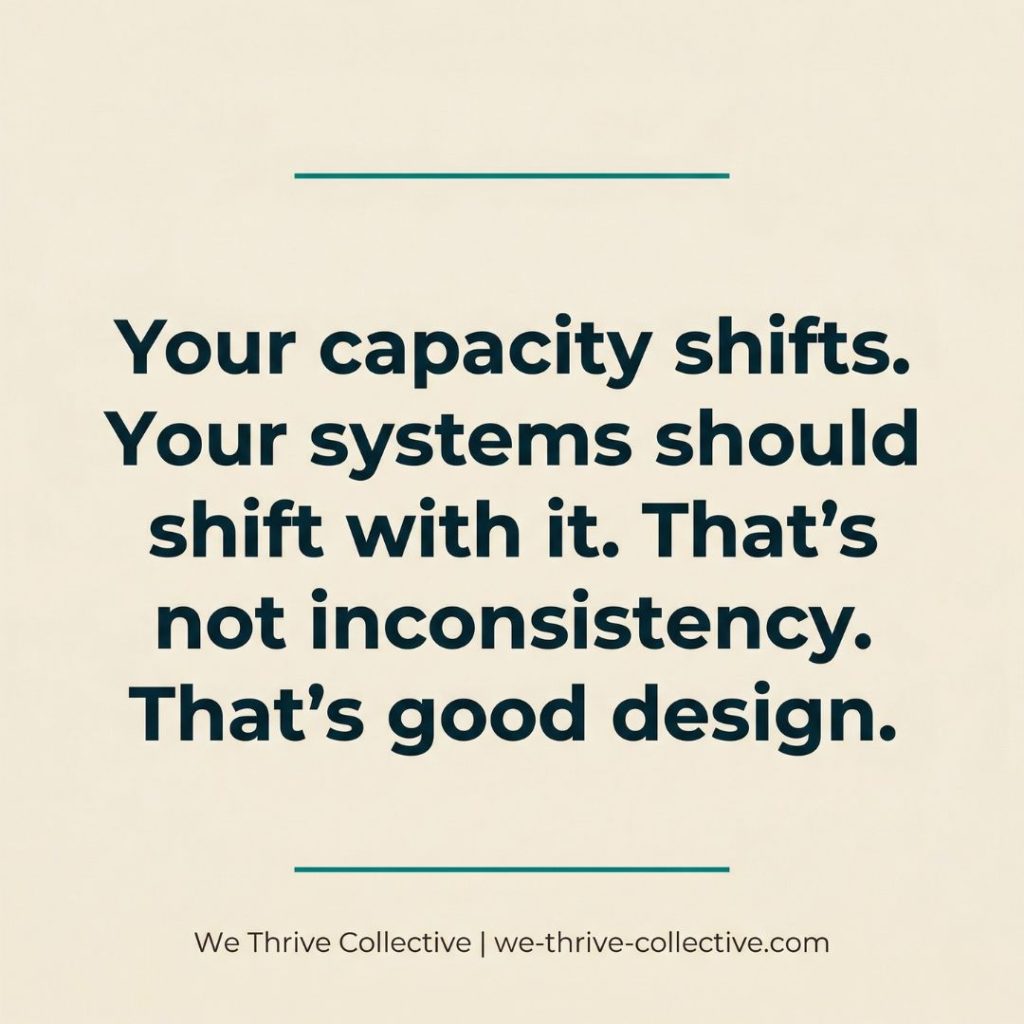
That’s not a follow-through problem. That’s a design mismatch. Rigid planning assumes consistent energy, predictable days, and a brain that thinks in straight lines. Soft structure for sustainable business starts from a different assumption: your capacity shifts, and your systems should shift with it.
Five shifts that make flexible planning actually stick.
Why Traditional Planning Breaks for Most Founders
Traditional business planning assumes you’ll follow the same routine daily. It expects steady energy and linear execution with clean handoffs from one step to the next.
Harvard Business Review documented what many founders already know: forcing neurodivergent people into rigid structures causes more harm than help. The most effective systems adapt to the person, not the other way around.
For service-based founders especially, the weeks are rarely identical. Client emergencies shift priorities. Energy dips after intensive project stretches. The plan you made Monday morning is irrelevant by Wednesday afternoon. That’s not failure. That’s reality.
A soft structure business model accounts for that reality instead of pretending it doesn’t exist.
5 Real Shifts to Build Soft Structure
Shift 1: Replace Time Blocks With Energy-Based Batching
Time blocking assumes every Tuesday at 2pm feels the same. It doesn’t. Energy-based batching groups tasks by the type of energy they need: creative work when your brain is firing, admin when it’s coasting, rest when it’s done.
This is the foundation of a soft structure business model. Your schedule has containers, not cages. The containers hold the same categories of work, but when you fill them shifts based on what your week actually looks like.
Shift 2: Define Three Priorities Per Week, Not Ten
When everything feels urgent, nothing moves forward. Pick three things that matter this week. Everything else is maintenance or can wait.
Capacity-aware business systems run on clear priorities, not overloaded to-do lists. “Is this one of my three?” becomes the filter for every request, every distraction, every bright idea that tries to hijack your afternoon. For a deeper look at how this works, this post on how clarity reduces overwhelm walks through the full approach.
Shift 3: Build Repeatable Systems for Recurring Work
If you’re doing the same task more than twice, it’s time to systemize it. Client onboarding, follow-up sequences, invoice reminders, content batching. These don’t need your hands on them every time.
Flexible business planning still needs systems. The difference is those systems hold the repeatable stuff so your creative energy stays available for the work that needs you present. Simplifying your business systems is a solid starting point if your current setup has grown beyond what you actually use.
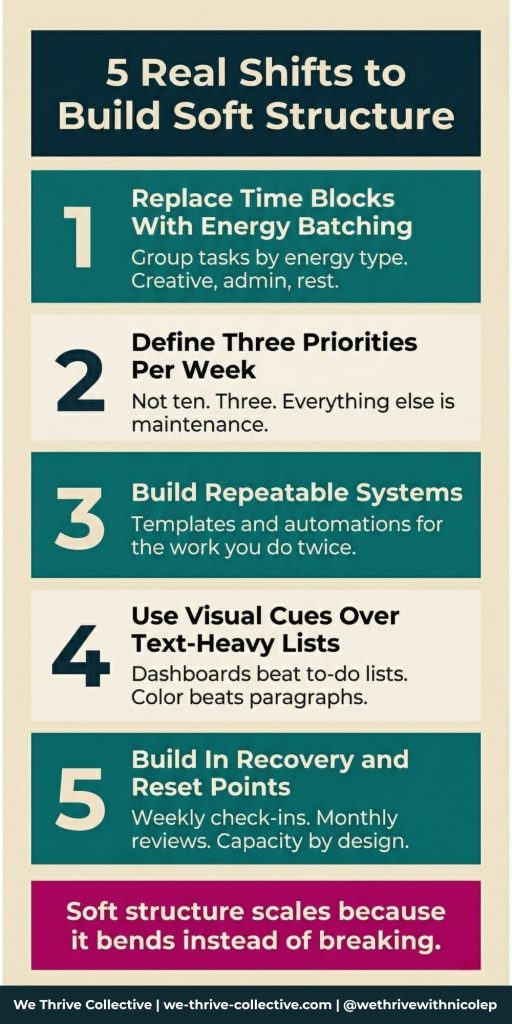
Shift 4: Use Visual Cues Over Text-Heavy Lists
If your project board requires reading three paragraphs to figure out what’s next, it’s not designed for how most founders actually think. Dashboards beat to-do lists. Color-coded pipelines beat text-heavy project boards.
Energy-based business planning works best when you can see your week at a glance. Visual organization reduces the cognitive load of figuring out where you are and what comes next. When your brain doesn’t have to decode the system, decisions get faster and less draining. Entrepreneur highlights how decision fatigue costs small business owners both money and momentum.
Shift 5: Build In Recovery and Reset Points
Rigid systems assume steady energy. Soft structure accounts for the crash after the hyper-focus sprint, the day when everything feels heavy, the week where capacity drops.
Build reset points into your systems. A weekly 10-minute review. A monthly “what’s creating friction” check-in. When your systems include recovery by design, falling off track stops being a failure and starts being iteration. For neurodivergent founders especially, building systems that match your brain is one of the most effective ways to protect sustainability at the operational level.
Frequently Asked Questions
What is soft structure for sustainable business?
Soft structure for sustainable business is a flexible planning approach that uses repeatable containers instead of rigid routines. It means energy-based batching instead of time blocking, clear weekly priorities instead of overloaded lists, and built-in recovery points so your systems adapt to your capacity rather than demanding consistency your brain can’t sustain.
How is soft structure different from no structure?
Soft structure has clear boundaries and repeatable systems. The difference is that those boundaries flex with your energy and capacity instead of breaking when your week doesn’t match the plan. It’s structured enough to create consistency and flexible enough to last.
Can soft structure work for a growing business?
Yes. Soft structure scales better than rigid planning because it adapts as your business grows. The containers expand. The automations handle more volume. The visual systems accommodate more complexity without adding proportional cognitive load.
What tools support a soft structure business model?
Look for platforms that combine CRM, scheduling, automations, and visual dashboards in one place. The fewer context switches, the better. The tool should match your working style and reduce cognitive load, not add to it.
How do I start building soft structure in my business?
Start with one shift. Pick the one that addresses your biggest source of friction right now. Replace one rigid routine with an energy-based container, or define three priorities for next week instead of ten. Small structural changes compound faster than most founders expect.
Structure doesn’t have to feel like a cage. The best systems hold your work without holding you down.
Pick one shift from this list. Whichever one made you exhale a little just reading it. That’s your entry point.