Inclusive Design for Business: 4 Honest Reasons It Pays
You added closed captions to your webinar because one attendee asked. Three months later, your replays had double the engagement because people were watching in waiting rooms, on muted phones, and during commutes. The thing you did for one person improved the experience for everyone.
That’s the curb-cut effect in action. And it’s the core argument for inclusive design for business: features built for specific needs end up making systems better for all users. This isn’t charity work. It’s strategic design.
Four reasons building for more people pays off in ways that show up in your numbers, your trust metrics, and your retention.
What Inclusive Design Actually Means
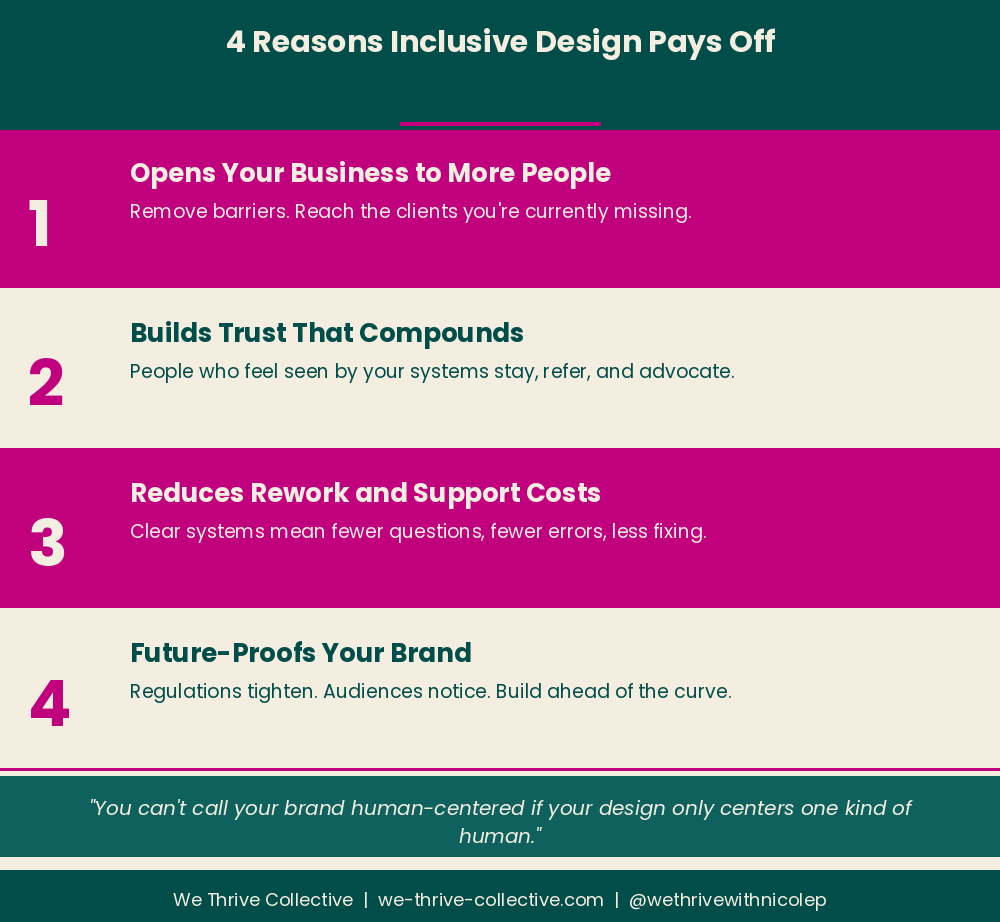
Inclusive design means building systems, products, and experiences with the assumption that your users are diverse. Different abilities, processing styles, languages, devices, energy levels, and life circumstances. It’s not an accessibility checklist you run at the end. It’s a design philosophy you apply from the start.
The Stanford Social Innovation Review named this the curb-cut effect: when sidewalk curbs were cut for wheelchair users, travelers with luggage, parents with strollers, and delivery workers with carts all benefited. Accessible Web documents seven ways accessibility innovations originally built for disabled users now serve everyone.
When your inclusive design for business approach starts with the people who face the most friction, the result is systems that work better for all users.
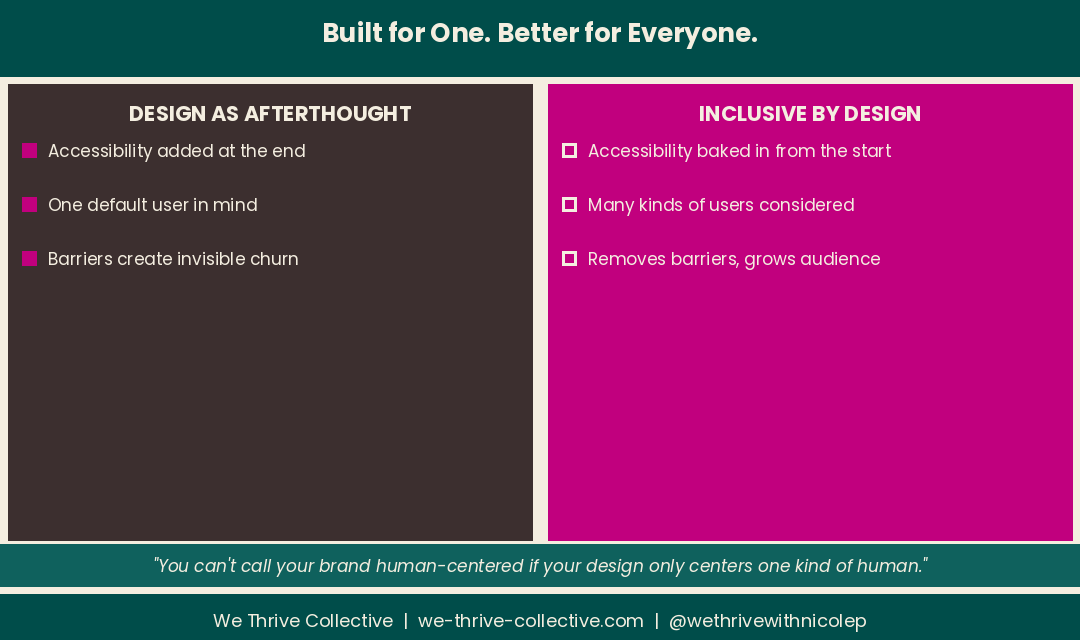
4 Reasons Inclusive Design Pays Off
1. It Opens Your Business to More People
When your forms aren’t keyboard-navigable, your content isn’t captioned, or your automations assume a linear path that doesn’t match how real people move through decisions, entire groups of potential clients can’t engage with your work. One in four Americans has a disability. Neurodivergent professionals are shaping industries. The people you’re missing aren’t a small edge case.
Inclusive design removes barriers that push people away before they ever reach your offer.
2. It Builds Trust That Compounds
When people feel seen by your systems, they stay. They refer. They talk about the experience. Trust built through accessible design has a longer half-life than trust built through marketing alone.
Inclusive systems signal that you’ve thought about the person on the other end, not just the conversion. For clients who have been underserved by generic business tools, that signal carries weight. It’s the difference between a brand that talks about values and a brand that builds them into the infrastructure. Neurodivergent-friendly business systems shows what that looks like operationally.
3. It Reduces Rework and Support Costs
Inclusive systems are clearer systems. When your language is plain, your navigation is flexible, your processes don’t assume a single path, fewer people get stuck. That means fewer support requests, fewer abandoned workflows, and less time rebuilding things that weren’t built right the first time.
Accessible alt text, readable fonts, video captions, low-stimulation design options, neurodivergent-friendly flows. These aren’t extras. They’re the difference between a system people use and a system people avoid. For a practical look at how simplification connects to clarity, simplifying your business systems covers the consolidation process.
4. It Future-Proofs Your Brand
Accessibility regulations are tightening. Audiences are paying closer attention to how businesses build, not just what they sell. Building inclusively now means you’re ahead of the curve instead of scrambling to catch up when standards shift.
This isn’t about being perfect. It’s about building with intention. Start with one question: who does my current system exclude? Then fix the first thing you find. For a broader look at values-based decision-making, why sacred values shape better businesses covers the full framework.
Frequently Asked Questions
What is inclusive design for business?
Inclusive design for business means building your systems, products, and client experiences with diverse users in mind from the start. It accounts for different abilities, processing styles, languages, and devices. Rather than adding accessibility at the end, it makes inclusion part of the design process so more people can engage with your work.
What is the curb-cut effect in business?
The curb-cut effect describes how features built for one group end up helping everyone. In business, this means systems designed for accessibility, like plain language, flexible navigation, or captioned content, improve the experience for all users, not just those the feature was originally built for.
Does inclusive design cost more to implement?
Starting with inclusive design often costs less than retrofitting. When you build clear systems from the start, you reduce support requests, abandoned workflows, and rework. The upfront investment pays back through better engagement, broader reach, and fewer fixes down the line.
How do I start with inclusive design in my business?
Start by auditing your current client experience for barriers. Check whether your forms are keyboard-navigable, your language is plain and clear, your content has captions and alt text, and your automations account for different paths. Fix the first friction point you find and build from there.
Why should entrepreneurs care about accessible systems?
Accessible systems reach more people, build stronger trust, and reduce the friction that drives clients away. One in four Americans has a disability. Neurodivergent professionals are a growing segment of the market. Building for them is building for a broader, more loyal audience.
Inclusive design isn’t a trend or a compliance checkbox. It’s what building with intention actually looks like when you follow it all the way through.
Start with the first barrier you can identify. That’s the door someone else has been waiting for you to open.