Breaking Barriers for Neurodivergent Entrepreneurs: 3 Real Fixes
You sat through another webinar about “consistency” and “focused execution” from someone who has never had to bargain with their own brain to open a laptop. The advice sounded right. The system they recommended looked clean. And none of it accounted for the fact that your executive function had already checked out before the second module loaded.
Breaking barriers for neurodivergent entrepreneurs starts with naming the real problem: the infrastructure was never built for your brain. Not the motivation. Not the ambition. The systems.
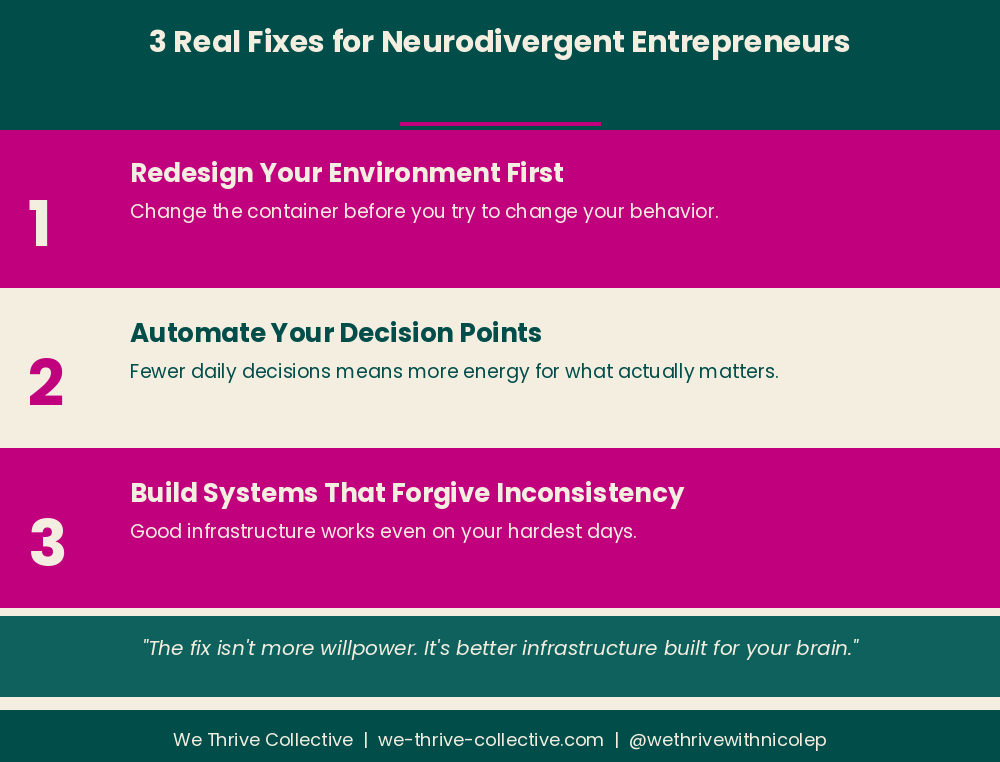
Three fixes that address what actually gets in the way.
The Barriers Nobody Names Out Loud
Most mainstream business advice follows a pattern: be consistent, stay focused, follow the formula. If you have ADHD, autism, dyslexia, or any combination, that advice can feel like being handed a map in a language you don’t speak.
Harvard Business Review documented the harm of expecting neurodivergent professionals to mask and adapt to neurotypical norms. Understood.org explains how executive function differences affect planning, task initiation, and working memory in ways that standard productivity systems ignore entirely.
The barriers are real. Executive function differences can derail a solid strategy before it starts. Sensory and social stressors make networking feel like a trap rather than an opportunity. Decision fatigue hits faster and harder than most advisors account for. And stigma still lingers in spaces that call themselves progressive.
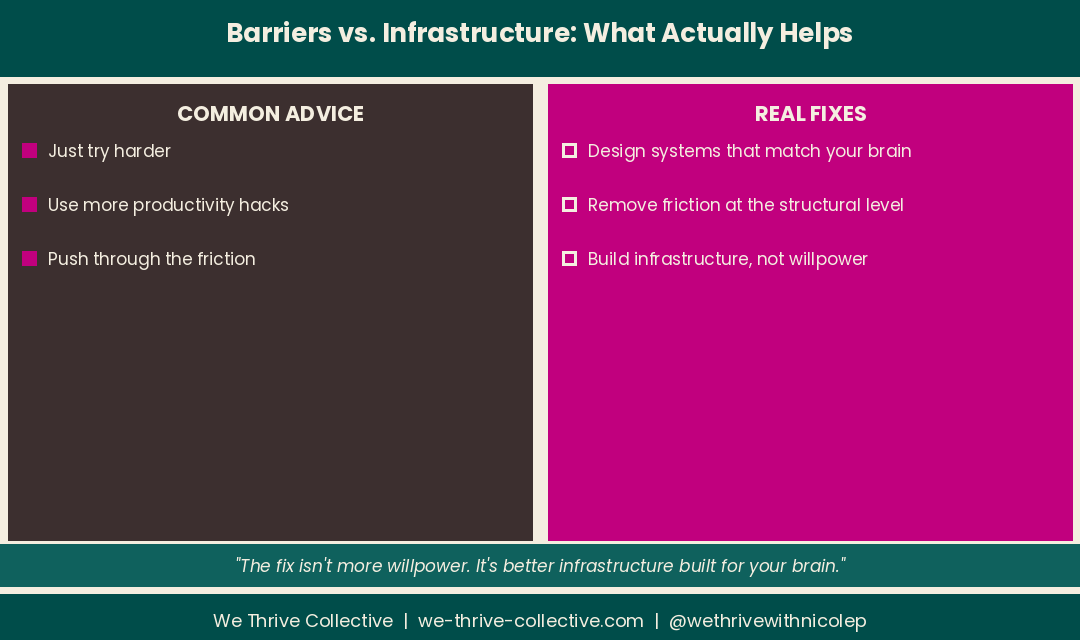
The fix isn’t more willpower. It’s better infrastructure.
3 Fixes That Address What Actually Gets in the Way
Fix 1: Tech That Works With Your Nervous System
The answer is not another app. Not another “just automate it” suggestion from someone who has never stared at a blank Zapier screen wondering where to start.
You need tools and workflows that feel clear, calm, and flexible. That means fewer platforms, less context switching, and visual dashboards that show you what needs attention without requiring you to hold everything in your head. When the tech matches your processing style instead of fighting it, the daily operations stop draining the energy you need for the actual work.
For a full look at what this means in practice, neurodivergent-friendly business systems covers the design principles. And if your first priority is reducing tool sprawl, simplifying your business systems walks through the consolidation process.
Fix 2: Strategy That Holds Your Ideas and Your Capacity
A good strategy session should leave you feeling clearer, not more overwhelmed. That means the person guiding you needs to hold your big ideas and your current capacity at the same time.
No shame. No “shoulds.” Just aligned action that works with your rhythm this week, this month, this season. Strategies that ignore energy variation break the first time your capacity dips. Strategies that account for it keep working because they were built for the person you actually are, not the version of you that shows up on your best day.
Fix 3: Community Where You Don’t Have to Mask
Breaking barriers for neurodivergent entrepreneurs requires spaces where it’s safe to lead without performing. Not another networking group where the loudest voice wins. Not a community you scroll through waiting to feel like you belong.
A space where you can experiment with systems, ask the question you’re afraid sounds basic, and get feedback from people who understand that your brain works differently because theirs does too. When neurodivergent thinkers are centered in business ecosystems instead of squeezed into existing ones, the result is systems that work better for everyone. Inclusive design as a business strategy makes the broader case for why that approach produces better outcomes across the board.
Frequently Asked Questions
What barriers do neurodivergent entrepreneurs face?
Neurodivergent entrepreneurs often face executive function challenges that affect planning and task initiation, sensory and social stressors that make networking draining, faster onset of decision fatigue, and ongoing stigma in business spaces. Standard business systems and advice typically ignore these differences entirely.
What kind of business support works best for ADHD entrepreneurs?
ADHD entrepreneurs benefit from tools with visual dashboards, reduced context switching, and calm interfaces. Strategy support should account for variable energy levels and avoid shame-based motivation. Community spaces where masking isn’t required build the trust and consistency that isolated work can’t replicate.
Can neurodivergent entrepreneurs run successful businesses?
Yes. Neurodivergent founders bring pattern recognition, creative problem-solving, and deep interest-driven focus that produce original business models and client experiences. The gap is usually infrastructure, not ability. When systems match how your brain works, the results speak for themselves.
How do I find business tools that match my brain?
Look for platforms that consolidate your core operations in one place with minimal logins and context switching. Visual dashboards, flexible workflows, and guided onboarding reduce cognitive load. Test tools against your lowest energy day, not your best. If a platform only works when you’re at full capacity, it’s the wrong tool.
Why don’t standard business frameworks work for neurodivergent founders?
Standard frameworks assume consistent energy, linear execution, and a single processing style. Neurodivergent brains have variable capacity, different working memory structures, and distinct attention patterns. Frameworks that don’t account for these differences create friction that compounds over time instead of building momentum.
Neurodivergence isn’t a limitation. It’s a different kind of intelligence. The infrastructure just needs to catch up.
Start with the barrier that costs you the most energy every week. That’s the first one worth removing.