Taming Time Blindness: 4 Honest ADHD Calendar Fixes
You meant to follow up with that client yesterday. Except yesterday was actually nine days ago. The meeting you thought was in the afternoon started at 10am. And the “quick task” you estimated at fifteen minutes just ate two hours.
Time blindness is how your brain experiences time when you’re wired for ADHD, autism, or other neurodivergent patterns. Taming time blindness starts with building systems that catch what your brain naturally drops instead of forcing yourself into a rigid planner.
Four calendar strategies that actually work with your wiring.
What Time Blindness Actually Is
Time blindness is a neurological difference in how your brain processes the passage of time. ADDitude Magazine describes it as the inability to sense how much time has passed or accurately estimate how long tasks will take.
For ADHD entrepreneurs, this shows up everywhere. Deadlines sneak up. Meetings start before you’re ready. Weekly tasks vanish until someone reminds you. And that “quick follow-up” you meant to send? Three weeks later, you’re still carrying the guilt.
The real answer is design. When your ADHD calendar system acts like an external brain, catching what you might forget and surfacing what matters exactly when you need it, time stops being the enemy.

4 ADHD Calendar Fixes That Work
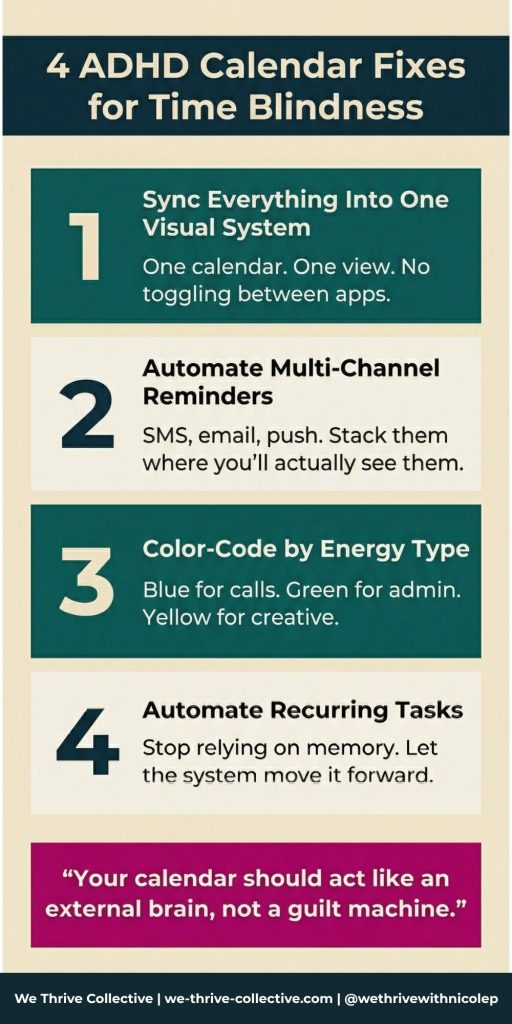
Fix 1: Sync Everything Into One Visual System
Stop toggling between Google Calendar, your project management app, and sticky notes on your monitor. When appointments, deadlines, and personal commitments live in separate places, your brain has to assemble the full picture every single time. That assembly step is where things slip.
An ADHD calendar system puts everything in one view. Client calls, deadlines, personal appointments, and follow-up tasks all land in the same place. One place to check before you start the day. One place to check throughout it. Understood.org confirms that external visual systems are one of the most effective supports for neurodivergent time management.
Fix 2: Automate Multi-Channel Reminders
The best reminder is the one you actually see. Single-channel reminders fail because you’re not always in the same mode. Set up automated notifications that hit you where you’re least likely to ignore them.
Text yourself an hour and then five minutes before a meeting if your phone is always nearby. Send an email the day before if you need prep time. Stack reminders: a gentle nudge in the morning and a final alert right before. Your calendar should ping you the way a friend would.
Fix 3: Color-Code Your Schedule by Energy Type
Your brain processes visual cues faster than words. Use that to your advantage.
Assign colors for task types: blue for coaching or client calls, green for admin, yellow for creative work. Color-code pipeline stages so you can see what’s urgent versus what can wait. With one glance, you can feel the shape of your week: which days are heavy, which are light, and where you can slot in rest or deep work.
This is ADHD-friendly productivity in practice. When the schedule is visual, decisions get faster and less draining. For a deeper look at how visual systems connect to business operations, this post on neurodivergent business systems covers the full approach to designing for how your brain works.
Fix 4: Automate Recurring Tasks
Monthly client check-ins. Weekly admin work. Quarterly invoicing. These aren’t hard tasks. They’re the ones that pile up in your mental to-do list, draining energy just to remember them.
Set recurring events so they automatically appear at the right interval. Attach them to workflows that send you prep notes, tasks, or checklists. Now you’re not relying on memory. The system quietly moves tasks forward while you focus on work that needs your active brain.
This is the core of neurodivergent time management: building systems that reduce mental load instead of adding to it. If your broader business systems need the same treatment, simplifying what you already have is the fastest way to reclaim that energy. And for founders looking at how to build planning that stays flexible long-term, soft structure for sustainable business walks through the broader approach.
Frequently Asked Questions
What is time blindness in ADHD?
Time blindness is the neurological difficulty of sensing how much time has passed or accurately estimating how long tasks will take. It’s common in ADHD and other neurodivergent conditions and reflects how your brain processes temporal information differently from what most systems expect.
How do I build an ADHD-friendly calendar system?
Start by consolidating everything into one visual calendar. Add multi-channel automated reminders (SMS, email, push notifications). Color-code tasks by energy type so you can see your week at a glance. Automate recurring tasks so your working memory doesn’t carry them.
Can automation actually help with time blindness?
Yes. Automated reminders, recurring task triggers, and workflow-based nudges reduce the number of things your brain has to track. When the system catches what your memory drops, time blindness stops creating the same spiral of missed deadlines and guilt.
What is the best calendar setup for neurodivergent entrepreneurs?
The best setup consolidates all appointments, tasks, and deadlines into one visual dashboard with color-coded categories, stacked multi-channel reminders, and automated recurring events. The fewer separate systems you check, the fewer things slip through the cracks.
How long does it take to see improvement with these fixes?
Most founders notice relief within the first week of consolidating calendars and setting up automated reminders. Deeper benefits compound over four to six weeks as the habits around one visual system replace the scattered approach and decision fatigue drops.
Time blindness is something I’ve navigated my entire life. The fix was never more willpower. It was designing a calendar that catches what my brain drops and shows me what matters exactly when I need to see it.
Start with one fix. Sync your calendars into one view. Set up your first stacked reminder. That’s enough to change how next Monday feels.