Sacred Values in Business Strategy: 6 That Shape Real Decisions
A client asked for a feature that would have looked great in a pitch deck. Revenue potential was obvious. The problem: building it would have required gating access to tools we’d already promised would stay open. We said no. Not because the idea was bad. Because it crossed a line we’d drawn before anyone was watching.
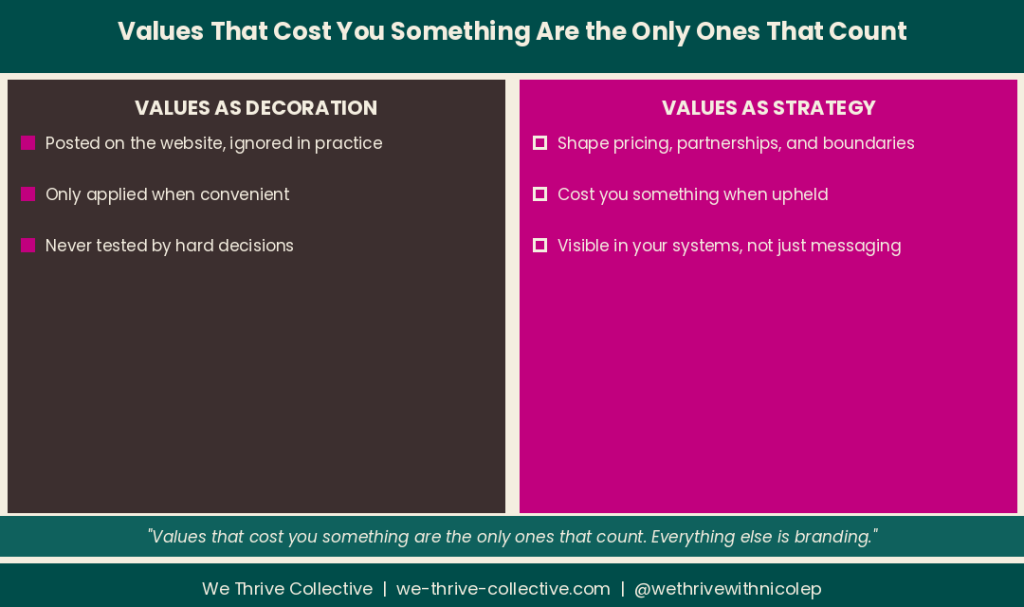
Sacred values in business strategy aren’t the inspirational words on your About page. They’re the decisions you make when saying yes would be easier and more profitable than saying no.
Six values that shape how We Thrive Collective builds. Not as brand decoration. As infrastructure.
What Sacred Values Actually Mean
“Sacred values” might sound abstract, but researchers define them as non-negotiable beliefs people refuse to trade off even when it’s inconvenient or costly. They’re identity-level commitments that bypass utility logic and trigger strong emotional responses when crossed.
Psychology Today documents how values-based decision-making produces more consistent behavior and higher life satisfaction across contexts. Stanford Social Innovation Review shows how values-driven organizations build structures that serve broader populations precisely because their design starts from a principled foundation rather than a market opportunity.
In business, sacred values in business strategy means your values aren’t a marketing layer. They’re the filter every system, offer, and client relationship passes through before it goes live.
6 Values That Shape How We Build
1. Integrity
You’ll never get performative hype or sleight-of-hand strategy from this work. If something doesn’t work, you hear it straight. If something works, you hear why. Clients get honest, grounded feedback rooted in what’s actually happening in their business, not what sounds good in a testimonial.
2. Autonomy
Every system we build gives you back your agency. Not makes you dependent on ours. No gatekeeping. No tech dependency loops. Clean, clear pathways you can control and evolve as your business grows. The goal is always that you can run it without us if you choose to.
3. Equity
Accessible design. Values-conscious pricing. Inclusive automation logic. Trauma-aware copy. We consider the ripple effects of every decision and every deliverable. This isn’t performative. It’s the operational standard. For a full look at how this shows up in practice, inclusive design as a business strategy covers the broader approach.
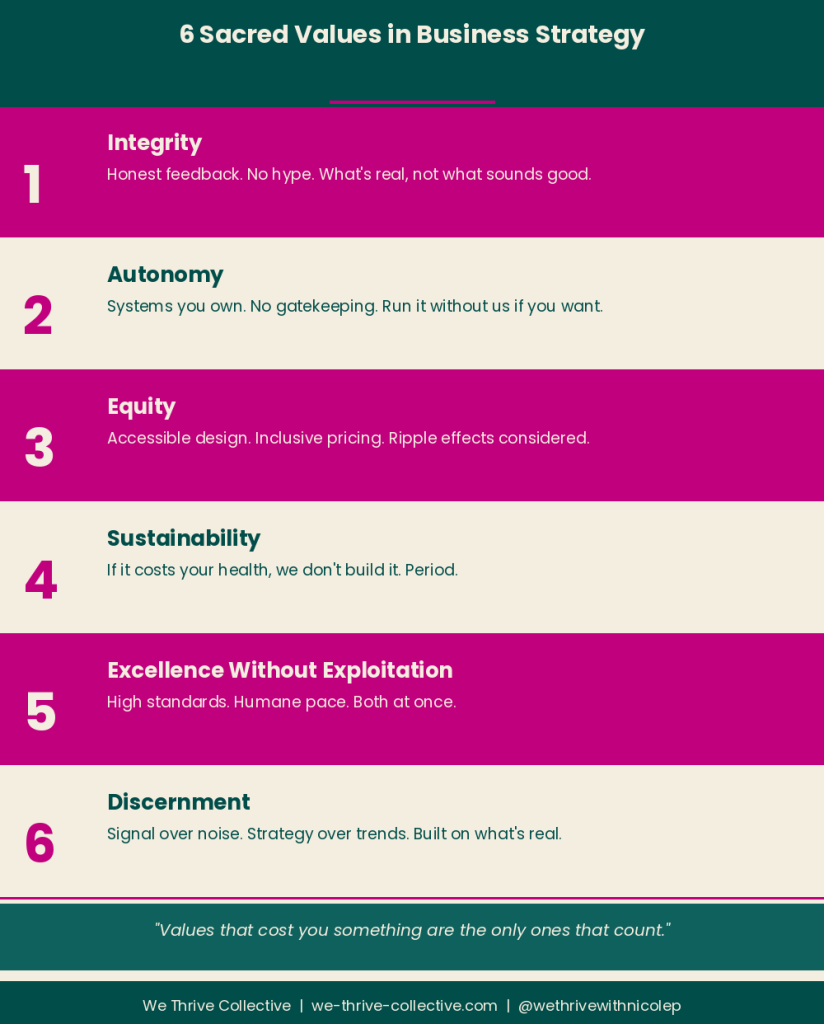
4. Sustainability
If a system doesn’t work for your life, your nervous system, or your long-term goals, we don’t build it. Systems that scale at the cost of the person running them aren’t sustainable. They’re a countdown. We build systems that grow with you, not ones that consume you in the process. For a deeper look at how this connects to growth planning, redesigning growth with ease walks through the full approach.
5. Excellence Without Exploitation
High standards and humane pace are not mutually exclusive. We expect good work from ourselves and our clients. But not at the cost of health, team wellbeing, or dignity. The bar is set high. When we reach it, we raise it. Because the goal is making tomorrow better than today, not wringing everything out of today at tomorrow’s expense.
6. Discernment
Not every trend deserves your energy. Not every best practice is best for you. We teach clients how to separate signal from noise and build based on what’s real, not what’s trending. For a look at how this discernment plays out in the way we design neurodivergent-friendly systems, building systems that match how your brain works covers the operational layer.
Frequently Asked Questions
What are sacred values in business?
Sacred values in business are non-negotiable principles that guide every decision, system, and client relationship. They go beyond brand messaging and operate as a filter that determines what you build, who you serve, and where you draw lines even when crossing them would be profitable or convenient.
How do values affect business strategy?
Values shape which opportunities you pursue, which you decline, and how you design your systems and offers. When values are embedded in your operations rather than limited to your marketing, they create consistency that builds long-term trust with clients, collaborators, and your audience.
Can a values-based business still be profitable?
Yes. Values-based businesses often build stronger client retention, higher referral rates, and more aligned partnerships. The short-term cost of saying no to misaligned opportunities is offset by the long-term trust and sustainability that principled decision-making creates.
How do I identify my own sacred values?
Look at the decisions that cost you something. Where did you say no when yes would have been easier? Where did you hold a line that others didn’t understand? The values that show up under pressure, not just in planning sessions, are the ones that actually shape your business.
What’s the difference between brand values and sacred values?
Brand values are often aspirational statements used in marketing. Sacred values are operational commitments that cost something to maintain. The test is whether the value changes your behavior when following it is inconvenient, risky, or expensive. If it only shows up when it’s easy, it’s branding, not a value.
The values that shape your business aren’t the ones you list. They’re the ones that show up in the decisions nobody sees.
Ask yourself one question: what did I protect the last time it would have been easier to let it go? That’s your starting point.