Do You Need a CRM? 6 Real Signs for Service Founders
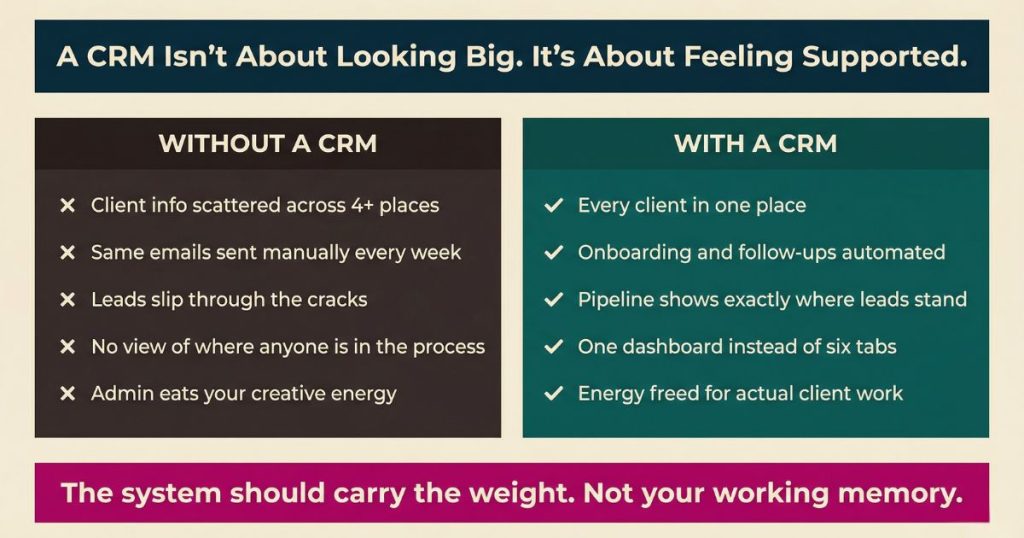
Your client info lives in four places. A Google Sheet you started six months ago. A Slack thread from last week. An email chain you can’t find. And your brain at 11pm, replaying whether you sent that follow-up.
If that pattern sounds familiar, the question isn’t really whether you need a CRM for your service-based business. It’s how long you’ve been needing one.
Six signs you’ve outgrown your current system, and what to look for when you’re ready.
The Real Cost of Not Having a Client Management System
Most service-based founders don’t start with a CRM. You start with what’s free and familiar: spreadsheets, email folders, calendar reminders. That works when you have three clients.
It stops working somewhere around client number eight, when you’re sending the same onboarding email for the fifth time and can’t remember who’s paid.
HubSpot’s research shows that professionals spend an average of 4.9 hours per week just searching for information across disconnected tools. For solo founders, that’s almost a full working day every week lost to systems that don’t talk to each other.
The cost goes deeper than time. It’s the low-grade stress of never knowing if something slipped through the cracks. That cognitive weight compounds. And it drains energy you should be spending on actual client work.
6 Signs You Need a CRM
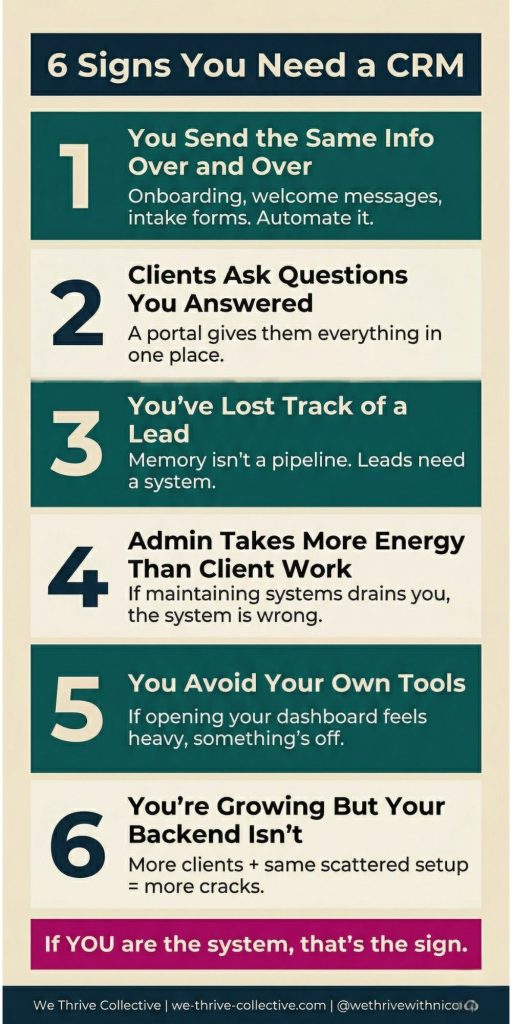
1. You Send the Same Information Over and Over
If you’re typing the same onboarding instructions, welcome messages, or intake questions every time a new client comes in, that’s a system’s job. A CRM for small business founders automates that repetition so your brain doesn’t have to carry it.
2. Clients Ask Questions You Already Answered
“Did you send that link?” “Where do I find my invoice?” “What’s my next step?” When clients can’t find what they need, both of you lose time. A client management system gives them a branded portal where everything lives in one place.
3. You’ve Lost Track of a Lead
Someone inquired two weeks ago. You meant to follow up. You didn’t. Now the window’s closed. If you’re relying on memory to manage your sales pipeline, leads will slip. That’s a systems design problem, not a follow-through one.
4. Admin Takes More Energy Than Client Work
When maintaining your systems drains more energy than the actual work you do for clients, something needs to change. The best CRM for solopreneurs reduces operational friction so your capacity goes where it matters.
5. You Avoid Your Own Tools
Research shows that roughly 50–55% of CRM implementations fail to deliver intended value, with poor user adoption consistently identified as the primary cause. Most often because the system doesn’t fit how people actually work.
6. You’re Growing But Your Backend Isn’t
More clients with the same scattered setup means more cracks, more mental load, and more things falling through. Growth should feel like expansion, not compression. A CRM for service-based business gives your growth somewhere structured to land.
If any of these sound familiar, this post on simplifying your business systems is a practical starting point. And for a full breakdown of what coaches should look for in a platform, this Kajabi alternative comparison covers the specific features that matter.
What to Look For in a CRM That Fits
Don’t pick the one with the most features. Pick the one that matches how you work.
Look for custom branding so it feels like yours. Simple, intuitive design you don’t need a manual to use. Essential tools you’ll actually touch: booking, email, forms, invoicing, automations. And enough flexibility that you can build workflows around your brain instead of someone else’s template.
If you’re neurodivergent, that last part matters the most. Neurodivergent-friendly business systems center visual thinking, energy-based work, and soft structure. The CRM should support that, not fight it.
Frequently Asked Questions
Do you need a CRM if you only have a few clients?
You don’t need a CRM just because of volume. You need one when your current setup creates friction, when you repeat tasks manually, when client info lives in too many places, or when admin drains energy you’d rather spend on client work. Even three clients can justify a system that holds everything.
What is the best CRM for solopreneurs and small service businesses?
The best CRM for solopreneurs handles client communication, scheduling, automations, and invoicing in one platform. Look for something that fits your working style, supports your brain, and doesn’t require bolting on five other tools. Soleila.io was built for service-based founders who need calm, cohesive operations.
How is a CRM different from a client portal?
A CRM tracks your full client relationship: leads, conversations, pipeline stages, and follow-ups. A client portal gives clients a branded space to access their info, documents, and deliverables. The best platforms combine both so everything lives in one system.
How do I know if my current tools are enough?
If you avoid your own tools, lose track of leads, manually repeat tasks weekly, or feel drained by admin, your tools are creating friction instead of removing it. The sign isn’t that you need more tools. It’s that you need the right one.
Can I switch to a CRM without starting over?
Yes. Most CRM migrations are simpler than founders expect. Start by auditing what you use, export what matters, and build your new system around your actual workflows. You don’t need a full rebuild. You need one calm platform that holds what your current setup scatters.
Your business deserves a system that holds the operational weight so you don’t have to. If you’ve been the system long enough to feel it, that’s the only sign you need.
Pick one thing from this list that made you nod. Start there.