
Delegate Business Tasks as a Solopreneur: 5 Simple Shifts

You’ve been the one holding everything. The client’s preferred meeting time. The follow-up sitting in drafts. The welcome packet you meant to finalize two weeks ago.
If you want to delegate business tasks as a solopreneur without handing off your standards, these five shifts are where to start.
Why Solopreneurs Find It Hard to Delegate Business Tasks
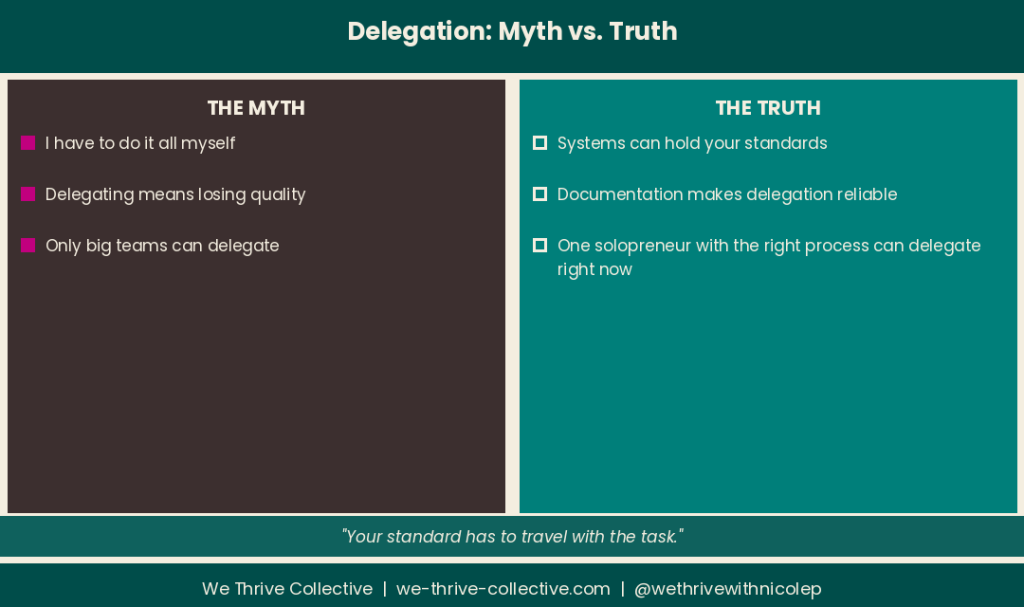
The hesitation to delegate usually comes from a real experience: you handed something off and it came back wrong. The tone was off. The email had no attachment. You cleaned it up and took the task back.
When that happens a few times, the math stops making sense. Why hand it off if you’re just going to catch it anyway?
But in most cases, the problem wasn’t delegation. It was that the standard didn’t transfer with the task. A process that holds your standard runs the same way every time, without you having to hold it in memory. According to SCORE, the most common barrier to small business delegation isn’t distrust of others. It’s the absence of documented process.
That’s a fixable problem.
What Needs Your Judgment vs. What Just Needs Consistency
Not everything in your business requires you specifically. Some things need your expertise and perspective. Others just need to happen the same way, reliably.
What needs your judgment: crafting a custom client proposal, navigating a genuinely difficult conversation.
What needs consistency, not necessarily you: onboarding emails, scheduling confirmations, invoice reminders, intake responses.
That second category can run on a system. When it does, you show up for the first one with actual capacity instead of borrowed attention.
This breakdown of how to simplify your business systems is a useful place to start figuring out where the lines fall in your own workflow.
How to Delegate Business Tasks as a Solopreneur: 5 Shifts
Shift 1: Document the decision, not just the task
Most delegation breaks down because the task transferred without the reasoning. Before handing anything off, write down what done looks like, what you’d correct if it came back wrong, and what your standard actually is. That’s what has to travel with the task.
Shift 2: Start with your most repeatable client process
Client onboarding is the best place to begin. It happens with every client, follows predictable steps, and you’re probably rebuilding it from memory each time. Automating one onboarding sequence reclaims the mental space you’ve been spending on logistics.
Shift 3: Let automation handle the memory work
Follow-up reminders, scheduling confirmations, invoice nudges, intake acknowledgments. These don’t need your judgment. They need a trigger and a template. Soleila.io, a HighLevel-based business operating system built for service providers, has these workflows designed in so you’re not reconstructing them from scratch each cycle.
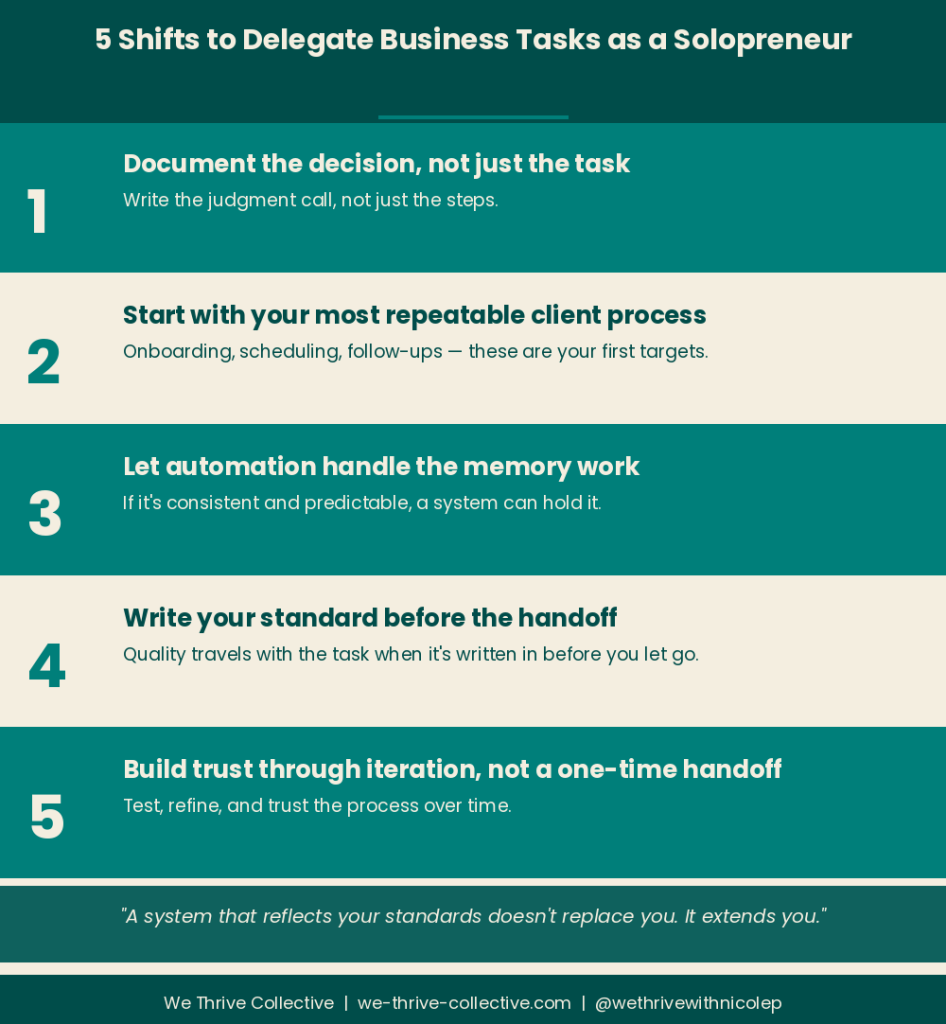
Shift 4: Write your standard before the handoff
Whether you’re building an automation or bringing in a contractor, write your standard down before the work starts. Not a vague description. A specific example of what right looks like. The standard has to be in the system, or it doesn’t survive the transfer.
Shift 5: Build trust through iteration, not a single handoff
Give the system or person one task. Review what comes back. Refine it. Assign the next one. Trust builds through a feedback loop, not through hoping the first handoff goes perfectly.
The Functioning & Feral™ Hub is built for exactly this kind of steady, iterative work: strategy and accountability for founders who want to grow at a sustainable pace without overhauling everything at once.
What Delegating Business Tasks Actually Looks Like in Practice
A solo coaching business owner had a three-step onboarding process she rebuilt manually with every new client. Contract email, calendar invite, welcome packet. She automated all three in one afternoon. Now the sequence fires the moment a contract is signed. She reviews one summary report per week.
That’s not losing your standards. That’s building a system that holds them so you don’t have to.
For more on what this kind of structure looks like when it’s designed for a neurodivergent brain, this post on neurodivergent business systems goes into the structure piece in depth.
Start with one process. See how it holds. Build from there.
Frequently Asked Questions
What does it mean to delegate business tasks as a solopreneur if I have no team?
Delegating as a solopreneur means moving recurring tasks from your memory to a system, automation, or documented process. You don’t need employees to delegate effectively. A CRM workflow, a templated intake sequence, or a pre-written follow-up email handles tasks the same way a team member would, without requiring your attention each time it runs.
How do I delegate business tasks without losing the quality my clients expect?
Quality doesn’t depend on you doing every step personally. It depends on your standard being present when the work gets done. Document what done looks like before anything leaves your hands. When your standard is written into the system or process, quality travels with the task instead of depending on your direct oversight.
How many business tasks can a solopreneur realistically move to systems?
Most solopreneurs can shift 30 to 50 percent of recurring tasks to systems without losing the personal touch clients value. Start with what repeats most often: onboarding, scheduling, follow-ups, and invoicing. Once those run reliably on their own, evaluate what else in your workflow runs on pure consistency rather than genuine judgment.
Is it worth building systems before I have consistent revenue?
Systems are a capacity decision, not a revenue threshold. Moving predictable tasks to a system earlier gives you more energy for client work and business development from the start. Waiting until you’re already overextended to begin building systems means starting when you have the least capacity to set them up thoughtfully.
What’s the best first step to delegate business tasks as a solopreneur?
Pick one task you repeat every week that follows a predictable pattern. Write out every step, including the small decisions embedded in it. Then ask: could a system or template handle this reliably? If yes, build that first. According to the U.S. Small Business Administration, documented processes are among the clearest markers of a business built to grow without complete owner dependency.