Tech for Non-Technical Founders: 5 Real Truths
You opened the new tool, followed the tutorial, and got stuck on step three. You closed it. Added it to the “maybe later” folder next to the other three apps you installed last quarter and never touched again.
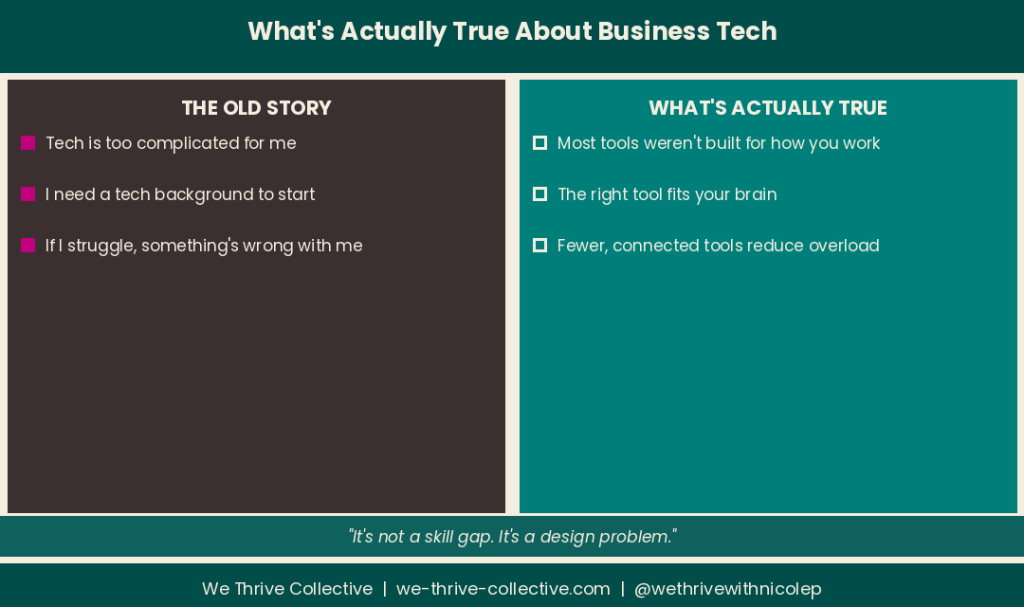
This isn’t a skill problem. Tech for non-technical founders exists. What you’ve been bumping into is a design problem, and that distinction matters.
What you’ve already tried has told you something real. The gap here isn’t willingness. It’s fit.
Why Business Tech Feels Like It Wasn’t Built for You
Most of the time, it wasn’t.
Business software is largely designed for organizations that have a dedicated ops person, a tech lead, or at minimum someone whose job is managing the tools. When a solo service provider sits down with that same software, they’re expected to navigate the same learning curve with less support and a lot less time.
That’s not a skill gap. That’s a product mismatch.
When the product isn’t designed for how you work, effort doesn’t close the gap. You can read every tutorial and still walk away feeling like the problem is you. It’s not.
The industry broadly hasn’t solved this. Most tools are designed to onboard a technical user who has space to explore. They’re not built for a founder who has 25 minutes before the next client call and needs the thing to just work.
There’s also a real compounding effect. If you’ve tried tools before, especially ones marketed as easy, and hit a wall anyway, every new tool starts from that memory. The hesitation you feel isn’t a character trait. It’s a reasonable response to friction you’ve already lived through.
What ADHD-Friendly Business Tools Do Differently
The right tech for non-technical founders doesn’t ask you to learn its logic before you can use anything. It moves with you.
ADHD-friendly business tools reduce the number of decisions required per session. Visual dashboards replace nested menus, and the tool surfaces the one next step instead of the full backlog at once.
Soleila.io, a HighLevel-based business operating system designed for service providers, was built around this principle. Your CRM, scheduling, automations, and client portal live in one place. Your functionality stays. What shrinks is the number of places your attention has to live.
Your capacity matters. The tools around you should be designed for it, not treated as irrelevant to it.
The question worth asking about any tool isn’t “can I learn this?” It’s “does this fit how my brain actually works?”
5 Truths About Tech for Non-Technical Founders
1. Complexity and capability are not the same thing
A tool with more features is not a better tool. The most useful tech for non-technical founders does the right things cleanly, not every possible thing in a way that requires a separate manual to navigate.
2. Long setup time is not proof of value
If a tool takes weeks to configure before it’s usable, that’s a product design choice, not a rite of passage. Tools built for capacity-aware founders account for the reality that setup often happens in twenty-minute windows, not eight-hour sessions.

3. Neurodivergent-friendly design helps everyone
You don’t have to identify as neurodivergent to benefit from software built with different brain wiring in mind. Clear visual layouts and predictable navigation reduce friction for anyone. But for founders whose attention or executive function works differently, these things are load-bearing. According to Harvard Business Review, neurodivergent thinkers often bring pattern recognition and non-linear problem solving that becomes an asset when the tools around them stop creating obstacles.
4. Your tech stack should shrink, not grow
Founders who feel overwhelmed by their tools are often managing too many platforms that don’t connect. Each disconnected app is another place something can fall through. Consolidation reduces cognitive load even when the underlying functionality stays the same. It’s one core reason to evaluate what moving everything to one platform actually looks like before adding another subscription to the pile.
5. The right tool meets you where you already work
If a tool requires you to restructure how you think about your business just to use it, it’s the wrong fit. Tech for non-technical founders should map onto your existing workflow and tighten it. Not ask you to become a different kind of operator first.
What This Looks Like in Practice
A service provider had been avoiding her CRM for three months. Not because she didn’t need it. Because every time she opened it, there were twelve things she didn’t know how to do and one thing she actually needed.
Moving to a simpler, more visual setup changed the math. Similar capability. Design built for the way her brain navigates a screen. Within two weeks, she was logging in daily.
That’s the real shift: not learning more, but finding what was built for you.
The Functioning & Feral™ Hub, We Thrive Collective’s platform-agnostic membership for strategy and systems support, starts with this question before anything else. Whether you’re moving to Soleila or staying on your current stack, the work is the same: understanding what your business actually needs before choosing the tools to hold it.
That question, “what does my business actually need before we pick the tech,” is the one most founders skip. Asking it first changes everything that comes after.
Tech for non-technical founders doesn’t ask you to level up. It starts from where you already are. Head to we-thrive-collective.com to take the first step.
Frequently Asked Questions
What are the best tech tools for non-technical founders?
The best tech tools for non-technical founders are the ones that reduce decisions, not multiply them. Look for visual dashboards, simple navigation, and platforms that consolidate multiple functions into one place. Soleila.io, a HighLevel-based business operating system, brings CRM, scheduling, automations, and client communications together so your attention stays in one place.
How do I choose business tools if I’m not technical?
A tech tool is the right fit for non-technical founders when it maps onto your existing workflow without requiring you to learn a new logic system first. Test it on a real task you do regularly. If it creates more steps instead of fewer, it’s not designed for how you work, and it’s worth looking for an alternative.
What makes a business tool ADHD-friendly?
ADHD-friendly business tools reduce the number of decisions required in a single session. They offer clear visual layouts, a single dashboard instead of multiple apps, and prompts that show the next step rather than all steps at once. Fewer tabs, fewer menus, and fewer points of context-switching make daily use more consistent and less draining.
Do I need a tech background to use Soleila.io?
No. Soleila.io, a HighLevel-based business operating system, is designed for service providers who are not technical by background. The FOCUSED™ LaunchPad, included with Soleila, walks new users through setup over eight weeks with guided support. The system is built to fit how a capacity-aware founder actually operates, not how a developer thinks.
How many tools does a small service business actually need?
Most small service businesses need fewer tools than they’re currently running. A focused stack that handles client management, scheduling, follow-up, and communications in one platform is more effective than five separate apps. Consolidation reduces the cognitive cost of switching between systems and decreases the number of places things can fall through unnoticed.