Redesigning Growth with Ease: 4 Shifts That Stick
You launched the new offer on a Monday. By Wednesday, three clients had questions you hadn’t anticipated, your inbox felt like a second job, and the excitement had already curdled into something closer to dread. Not because the offer was wrong. Because the pace of change outran your capacity to absorb it.
Redesigning growth with ease means building momentum your nervous system can actually sustain. Not smaller goals. Not slower progress. Just change that lands without the crash that usually follows.
Four shifts that make growth feel like expansion instead of compression.
Why Growth Feels Hard When the Pace Is Wrong
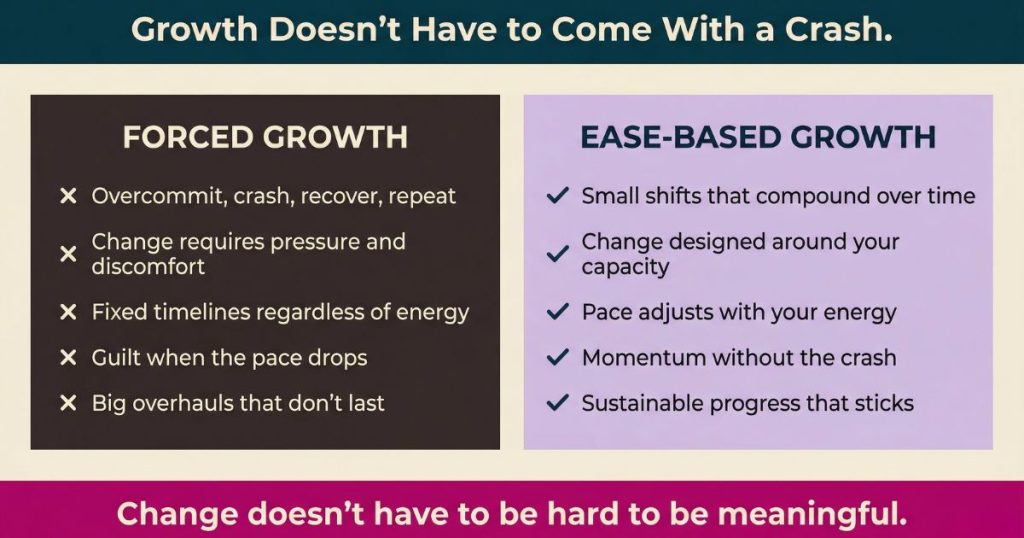
Growth in business is often framed as something that requires force, pressure, or a willingness to push through discomfort. That framing creates a specific pattern: overcommit, execute at full capacity, crash, recover, repeat.
Harvard Business Review documented what many founders already know: forcing people into rigid structures causes more harm than it solves. The same applies to growth timelines. When change is designed around an assumed energy level you don’t actually have, the result is resistance, not momentum.
The real problem is rarely the change itself. It’s the mismatch between the pace of change and the capacity you have available for it. Psychology Today confirms that incremental shifts produce more sustainable behavior change than dramatic overhauls.
Redesigning growth with ease starts from a different assumption: your capacity shifts, and your approach to change should shift with it.
4 Shifts That Make Growth Stick
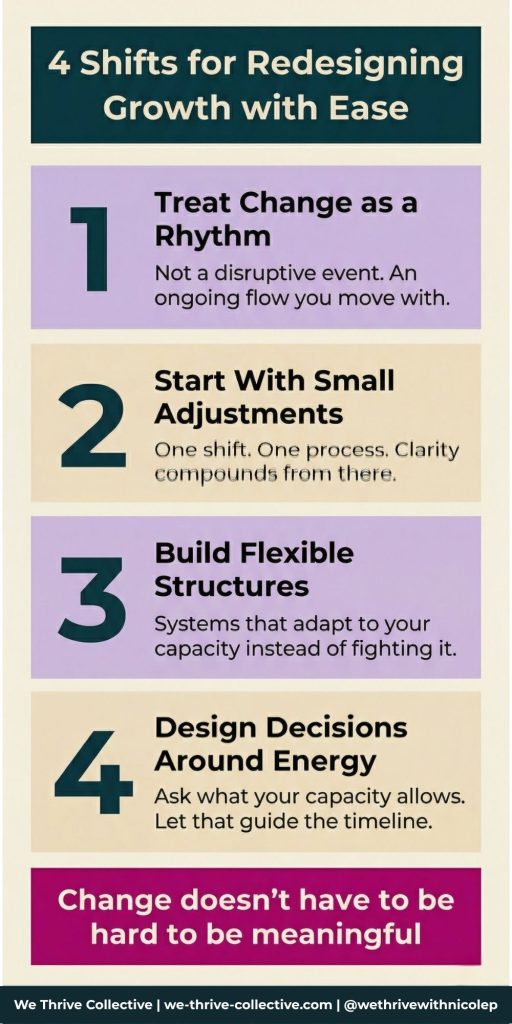
Shift 1: Treat Change as a Rhythm, Not an Event
Change is part of how growth naturally happens. It’s not a single disruptive moment you survive. It’s an ongoing rhythm you learn to move with.
When you pay attention to your natural cycles, when you think clearly, create easily, or need rest, you can introduce change at moments that feel supportive instead of forced. Growth doesn’t need to be rushed to be effective. When change follows your internal rhythm, it flows easier and lasts longer.
Shift 2: Start With Small Adjustments, Not Overhauls
Meaningful change rarely comes from tearing everything down. More often, it comes from one small, intentional adjustment.
Refining how you communicate with clients. Adjusting your working hours by thirty minutes. Streamlining a single process that creates friction every week. These shifts don’t look dramatic, but they create clarity. And over time, that clarity compounds. Momentum builds without requiring constant effort. When your systems feel clearer, it becomes easier to make decisions and move forward with confidence. For a deeper look at how this works, this post on how clarity reduces overwhelm walks through the full approach.
Shift 3: Build Flexible Structures That Support Your Energy
Rigid systems demand consistency without accounting for capacity. Over time, that demand depletes the energy you need for the actual work.
Flexible structures work differently. Instead of forcing you into a fixed routine, they adapt to how you function. Customizable templates, adaptable workflows, and technology that simplifies rather than complicates. The goal is support without pressure, structure without a cage. When systems are designed to work with you, they create stability without sacrificing ease. For a deeper look at how this works in practice, soft structure for sustainable business walks through the broader approach.
Shift 4: Design Decisions Around Energy, Not Just Timelines
Most business planning starts with a deadline and works backward. That works fine when your energy is predictable. It falls apart when it’s not.
Ease-based business growth means asking a different question before every decision: “What does my capacity allow right now?” Not “what should I be doing?” Not “what would the ideal version of me choose?” The version of you that’s here today, with the energy and bandwidth you actually have.
When you design decisions around energy instead of arbitrary timelines, the choices get clearer. And the outcomes last longer because they were built to match reality. For neurodivergent founders especially, building systems that match your brain is one of the most effective ways to protect sustainability.
Frequently Asked Questions
What does redesigning growth with ease actually mean?
Redesigning growth with ease means building momentum your nervous system can sustain. Instead of dramatic overhauls and forced timelines, it uses small intentional shifts, flexible structures, and energy-aware decision-making to create progress that sticks without the cycle of overcommit and crash.
How do I grow my business without feeling overwhelmed?
Start with one small adjustment that reduces friction in your current workflow. Build flexible systems that adapt to your energy instead of demanding consistency. Design decisions around your actual capacity, not an ideal version of your schedule. Clarity compounds faster than pressure.
Can gentle business growth still produce real results?
Yes. Incremental shifts produce more sustainable outcomes than dramatic overhauls. Small changes compound over time, creating momentum that lasts because it was built to match your capacity. The pace may feel different, but the results are more consistent and more durable.
How do I know if my pace of growth is right?
If growth feels like expansion, you’re in a sustainable rhythm. If growth feels like compression, the pace is outrunning your capacity. Check your energy after a growth push. If you need days to recover, the pace needs adjusting, not your effort level.
What systems support ease-based business growth?
Look for platforms that combine CRM, scheduling, automations, and visual dashboards in one place with minimal context switching. The fewer separate tools you manage, the less cognitive load each decision carries. The system should match your working style and adapt to your energy.
Growth that lasts was never about pushing harder. It was about designing change your body and brain can actually absorb.
Pick one shift from this list. The one that made your shoulders drop half an inch. That’s your entry point.