FOCUSED™ Framework: 7 Simple Phases from Chaos to Calm
You’ve probably heard the advice: “Just systemize it.” And if you’ve ever stared at that sentence while three browser tabs crash into each other and your CRM blinks at you like an accusation, you know how hollow it lands. Most systems were designed for a brain that runs on routine, linear progress, and consistent energy. If that’s not your brain, the system doesn’t fail you quietly. It fails loudly, and then you blame yourself for it.
The FOCUSED™ Framework exists because of that gap. It’s the method behind every system built inside We Thrive Collective, from the tech stack we set up for you to the onboarding flows and content plans we design together. It has seven phases, and each one solves a specific kind of overwhelm that shows up in a real founder’s actual week.
This post is the complete walkthrough: what each phase is, what problem it solves, and how to tell which phase you need right now. You’ll likely come back to these phases more than once, because the phase you need shifts as your business changes. By the end, you’ll know where you are and what comes next.
Table of Contents
What Is the FOCUSED™ Framework?
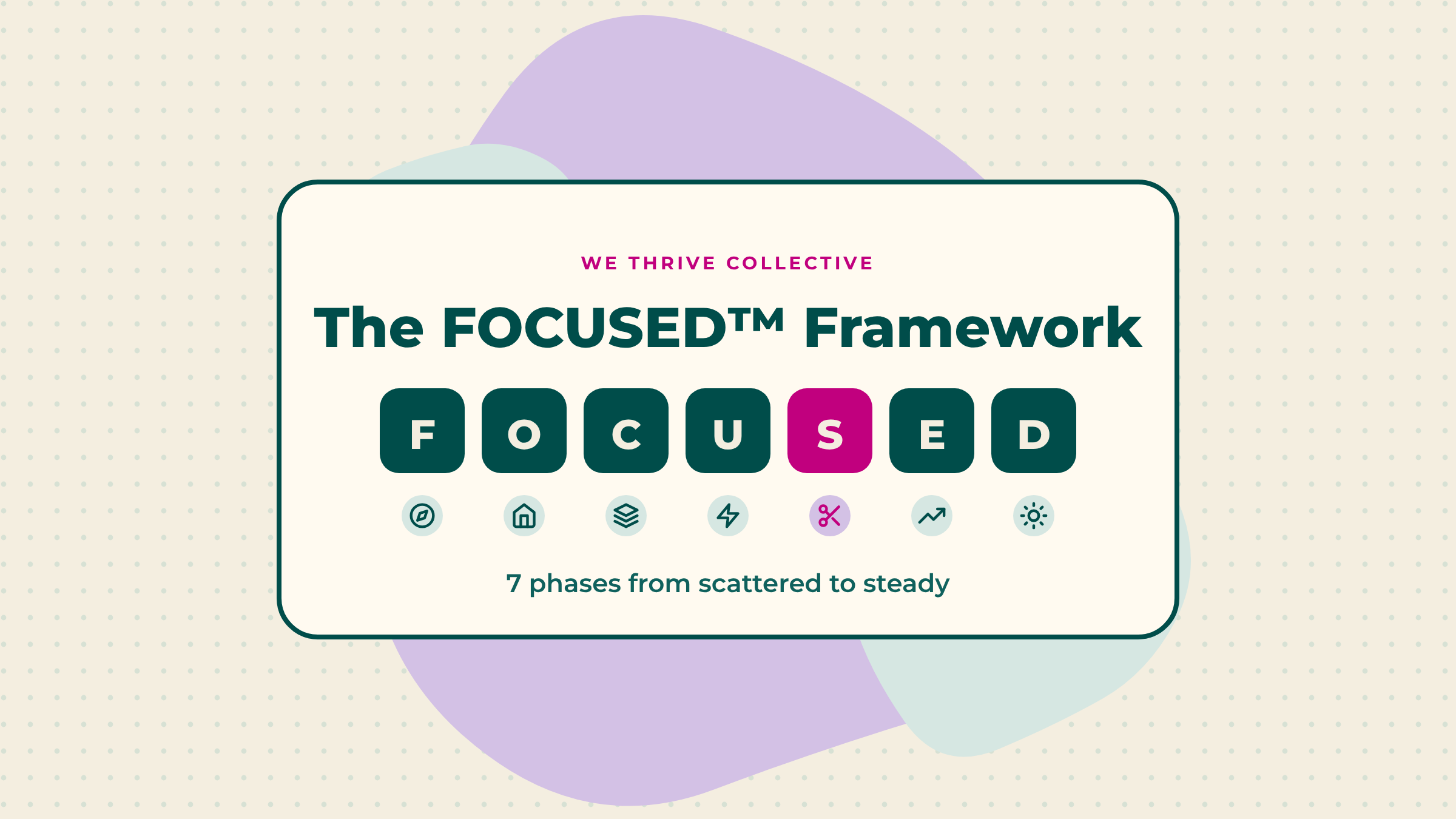
The FOCUSED™ Framework is a seven-phase method for building business systems that fit how neurodivergent founders actually work. I created it at We Thrive Collective, and it’s the structure behind every Soleila.io account, our white-labeled HighLevel business system.
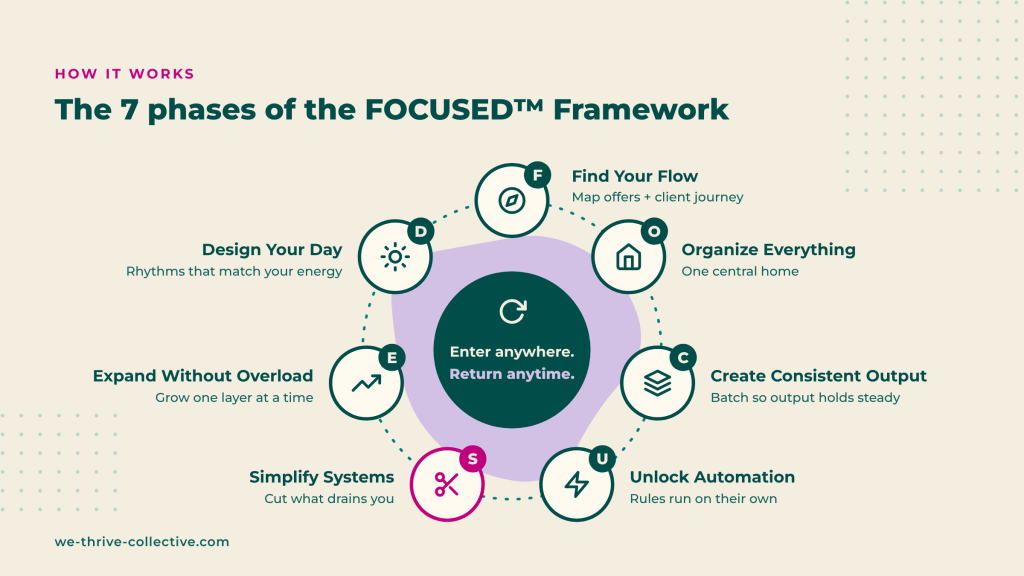
Each letter is a phase:
- F: Find Your Flow. Map your offers and your client journey.
- O: Organize Everything. Give all of your work one central home.
- C: Create Consistent Output. Batch your work and use AI so output holds steady when capacity dips.
- U: Unlock Automation. Hand rule-based tasks to workflows.
- S: Simplify Systems. Cut the tools and steps you don’t need.
- E: Expand Without Overload. Grow one layer at a time.
- D: Design Your Day. Build daily rhythms that match your real energy.
The phases work as places you can return to. You can enter at any phase and come back to any of them as your business changes.
If you want the background on why neurodivergent entrepreneurs need different business systems, that post covers the why. This one covers the how.
Find Your Flow and Organize Everything (Before You Build Anything Else)
F and O are the foundation phases. You map what you’re building, then you give all of it one home.
Here’s the scenario most founders know by heart: you spend a weekend setting up a new project management tool, connect it to your email, add a few automations, and feel genuinely good about it. Then a client asks for their invoice and you find it in a Google Doc, a Gmail draft, and possibly a sticky note. The tool was real. The plan was missing.
That’s exactly what the F and O phases of the FOCUSED™ Framework exist to prevent.
F: Find Your Flow (Map What You’re Actually Building)
Find Your Flow is a clear-eyed look at your core offers and your client journey, from the moment someone discovers you to the moment they complete working with you.
Before you build anything, answer these four questions:
- What do you actually offer? Name the offer, the deliverable, and the outcome.
- Who moves through that offer? Trace the path a client takes, step by step.
- Where does the handoff happen? Identify every point where something needs to transfer: an email, a form, a file, a calendar link.
- What breaks when you’re at low capacity? That’s your first automation target.
This phase gives you a blueprint. Without it, every tool you build is a room with no house around it.
O: Organize Everything (Give the Blueprint a Home)
Once you know what you’re building, the O phase is about centralizing it. Tasks, content ideas, client notes, automations, all of it moves into one place instead of living across four apps you opened in different seasons of motivation.
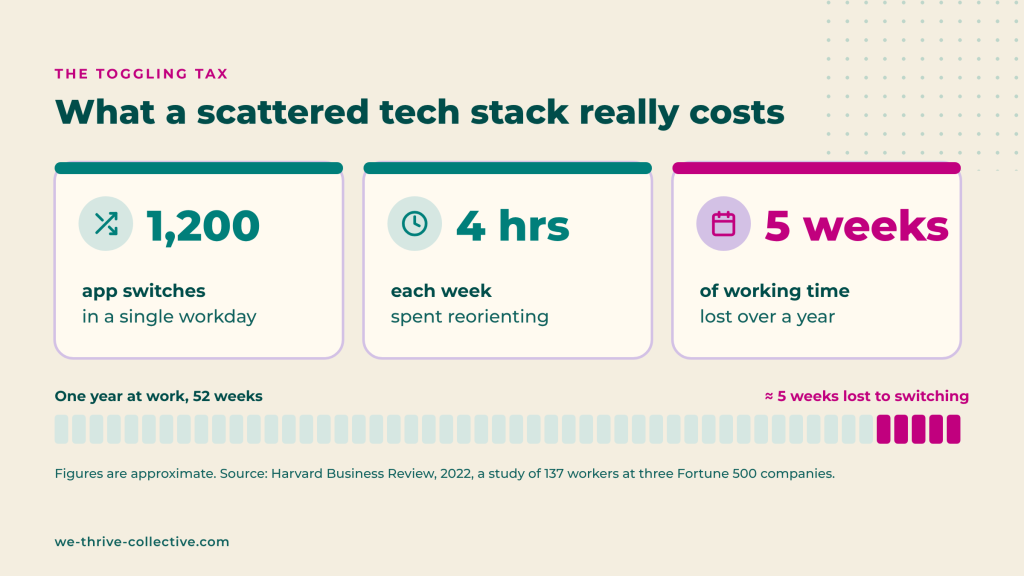
That scattered stack has a real cost. In a Harvard Business Review study of workers at three Fortune 500 companies, people toggled between apps nearly 1,200 times a day and spent just under four hours a week reorienting after those switches. Over a year, that adds up to roughly five working weeks (Harvard Business Review). For a neurodivergent brain that already spends energy managing task transitions, that number hits harder than it looks on paper.
One centralized system does two things a scattered stack cannot: it lets you pick up exactly where you left off on a low-capacity day, and it stops you from making the same decision twice.
When F and O are solid, the rest of the FOCUSED™ Framework has something to stand on. You know your offers, you know your client path, and you have one place where all of it lives. That one place is the difference between building a business and rebuilding it every three months.
Next, you’ll take that organized foundation into the C phase: creating consistent output without running on willpower.
Create Consistent Output and Unlock Automation (Without Running on Willpower)
C and U are the phases that keep your business moving when your energy doesn’t.
You’ve mapped what you’re building and organized where everything lives. Now comes the phase where most founders quietly stall out. Knowing what to do is rarely the issue. Doing it means showing up the same way every single day, and if your brain runs on interest and dopamine rather than discipline, that ask is unsustainable.
C: Create Consistent Output (Without Waiting for a Good-Brain Day)
Consistency means your audience, clients, and workflows don’t feel the difference when your capacity dips.
This is where AI assistants earn their place in your stack. They act as a production partner that holds the structure when you can’t, while the voice stays yours. In practice, that looks like batching. You sit down on a high-capacity day and generate the raw material. Your AI assistant, trained on your voice and your offers, helps shape that material into emails, social posts, onboarding docs, or client deliverables. One focused session can cover two weeks of output.
The goal is to stop rebuilding from zero every time you sit down to work.
U: Unlock Automation (Let the Workflow Run Without You)
Think about everything that happens after a client says yes: the confirmation email, the intake form, the welcome sequence, the first invoice, the follow-up reminder. If you handle each of those manually, you’re spending real cognitive energy on tasks that follow the exact same pattern every time.
That’s not a use of your brain. That’s a drain on it.
In a Zapier survey of knowledge workers at small and midsize businesses, 94% said they still perform repetitive, time-consuming manual tasks (People Matters). Solo founders carry all of those roles at once.
The U phase is about identifying which tasks run on rules (same trigger, same response, every time) and handing those to a workflow instead. Follow-ups, onboarding, reminders, invoicing: each one is a decision you make once and then stop making.
Automation is a structural answer to a structural problem. Discipline-based productivity assumes a steady baseline. Dopamine-driven motivation doesn’t work that way, and there’s nothing to fix about that. When the workflow runs on its own, your capacity is free for the work that actually needs you in the room.
Once C and U are in place, your system is doing real work between your sessions. That’s the foundation the next phase builds on.
Simplify Systems (The Phase Most Founders Skip and Then Regret)
Simplify Systems is the editing phase. You cut the tools and steps that cost more energy than they return.
You’ve got flow, structure, consistent output, and automation running. So why does it still feel like too much? That feeling is the signal. Editing is the part most founders skip entirely because it doesn’t feel like progress.
Adding a new app feels like progress. Simplifying feels like admitting something didn’t work. But here’s what’s actually happening: every tool you’re not fully using is a tab open in the back of your brain.
Larger organizations feel this too. BetterCloud’s 2025 State of SaaS report found companies used an average of 106 SaaS apps (BetterCloud). Your stack is smaller, but the math works the same way. Every app adds another login, another set of notifications, and another place where something can quietly break.
A different kind of chaos is still chaos.
Step 1: Audit what you actually use.
Go through every tool you pay for or log into. Ask one question: did I use this in the last 30 days in a way that directly served a client or moved an offer forward? If the answer is no, it goes on the cut list. Not a “maybe later” list. The cut list.
Step 2: Consolidate before you add.
Before you sign up for anything new, check whether a tool you already have does the job. Most founders are paying for overlap they don’t see because each tool was added to solve a problem the last tool created.
Step 3: Protect the system you’ve already built.
Simplicity protects your capacity for the work that actually matters. A lean, connected stack you actually understand will always outperform a sophisticated one you’re afraid to touch.
If you want a deeper walkthrough, this guide to simplifying your work systems breaks the process into four steps.
When you finish this phase, your business should feel quieter. Not smaller. Quieter. That’s the difference between a system that runs and one that just sits there taking up space.
Next, the E and D phases take that quiet foundation and build something you can actually grow on.
Expand Without Overload and Design Your Day (Growth That Fits Your Real Life)
E and D are the sustainability layer of the FOCUSED™ Framework. E protects your systems as you grow. D shapes your daily rhythm around how your brain actually operates.
You’ve built something real. The question now is how to grow it without rebuilding yourself from scratch every time you do. Together, E and D answer the question nobody asks early enough: what does this look like to maintain?
E: Expand Without Overload
Expansion feels exciting until it doesn’t. A new offer, a new platform, a VA you’re now managing: each addition creates drag on every system underneath it. The E phase asks you to test each growth move against what’s already working before you add it.
The check is straightforward: does this fit inside your current structure, or does it require rebuilding it? If a new offer needs a new funnel, a new tool, and a new workflow, the cost is higher than the revenue line shows. Expand one layer at a time, and let your existing systems tell you when they’re ready to hold more weight.
D: Design Your Day
This is where the framework gets personal. D is about building an external brain from the tools that catch what your memory won’t.
In practice, that means color-coded calendars so different types of work are visually distinct before you read a single word. It means task batching, grouping similar work together so your brain isn’t switching contexts every 20 minutes. It means energy-matched workflows, putting creative work in your high-capacity windows and admin tasks in the low ones, because you’ve watched your own patterns long enough to trust them.
I walk through my own setup in this ADHD-friendly calendar and automation guide.
The goal is a day you can re-enter. One where, if you lose two hours to a spiral or a kid emergency or a body that just stopped cooperating, you know exactly where you left off and what comes next without reconstructing the whole thing from memory.
That’s what the full FOCUSED™ Framework adds up to: a system built around how your brain actually operates, on the good days and the hard ones.
Which Phase of the FOCUSED™ Framework Do You Need Right Now?
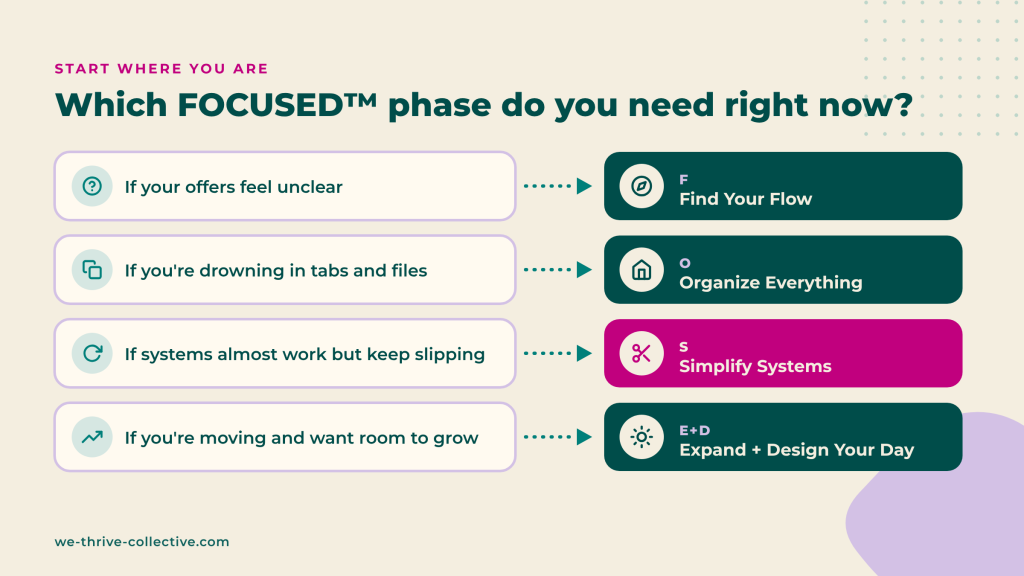
You don’t have to start at the beginning. That’s the part most framework guides won’t tell you.
The FOCUSED™ Framework is designed to meet you where you actually are. So before you close this tab and add “figure out my systems” to the list you’ll get to eventually, try this instead.
If your offers feel unclear (someone asks what you do and you give a different answer every time, or you’re not sure which thing to sell first), you’re in F territory. Start there. Map what you’re actually building before you touch another tool.
If you know what you’re selling but you’re drowning in tabs, duplicate files, and the low-grade panic of not knowing where anything lives, that’s O. You don’t need a new app. You need one organized place for everything you already have.
If you have systems but things keep slipping (automations that almost work, a CRM you update inconsistently, a workflow that depends on you remembering the next step), go straight to S. What you’re missing is simplicity.
E and D are for founders who are already moving and want growth that doesn’t quietly cost them everything outside of work.
You’ll likely move through more than one phase over time. That’s how iteration actually works.
Frequently Asked Questions
What is the FOCUSED™ Framework?
The FOCUSED™ Framework is a seven-phase method for building calm, sustainable business systems, created by Nicole Phommanorat of We Thrive Collective. The phases are Find Your Flow, Organize Everything, Create Consistent Output, Unlock Automation, Simplify Systems, Expand Without Overload, and Design Your Day. It was designed for neurodivergent founders whose energy and focus shift day to day.
Do I have to go through the FOCUSED™ phases in order?
No. You can start with whichever phase matches your biggest pain point right now. If your offers feel unclear, start with Find Your Flow. If your tools feel scattered, start with Organize Everything. If your systems almost work but keep slipping, start with Simplify Systems. Most founders return to different phases as their business changes.
Why do neurodivergent entrepreneurs need different business systems?
Most business systems assume steady energy, linear progress, and a reliable daily routine. Neurodivergent brains often run on interest, with focus and capacity that shift from day to day. Systems built for that reality use automation, one central hub, and visual cues, so the business keeps moving on low-capacity days instead of depending on willpower.
What should a solo business owner automate first?
Start with tasks that follow the same trigger and the same response every time. For most service providers, that means booking confirmations, intake forms, welcome emails, invoices, and follow-up reminders. A helpful test is to ask what slips when your capacity is low. Whatever breaks first is usually your best first automation.
How do I simplify my business tech stack?
List every tool you pay for or log into. For each one, ask whether you used it in the last 30 days to serve a client or move an offer forward. Cut anything that doesn’t pass that test. Before adding a new tool, check whether one you already have can do the same job.
Your Next Step
You don’t need a perfect system to start. You need the next right phase.
If you want to work through the phases with support instead of reverse-engineering them alone, the FOCUSED™ LaunchPad is the place to do that. If you’d rather start with one conversation about what your tech stack actually needs, a Tech Stack Chat will tell you more in an hour than another month of researching tools.
Either way, the goal is the same: a business that runs steady, takes care of your clients, and still leaves something in the tank for you.